
AI Agent Access Control: Prevent Cross-User Knowledge Base Leaks
By Erin Harris, AI Strategy & Business Transformation Consultant
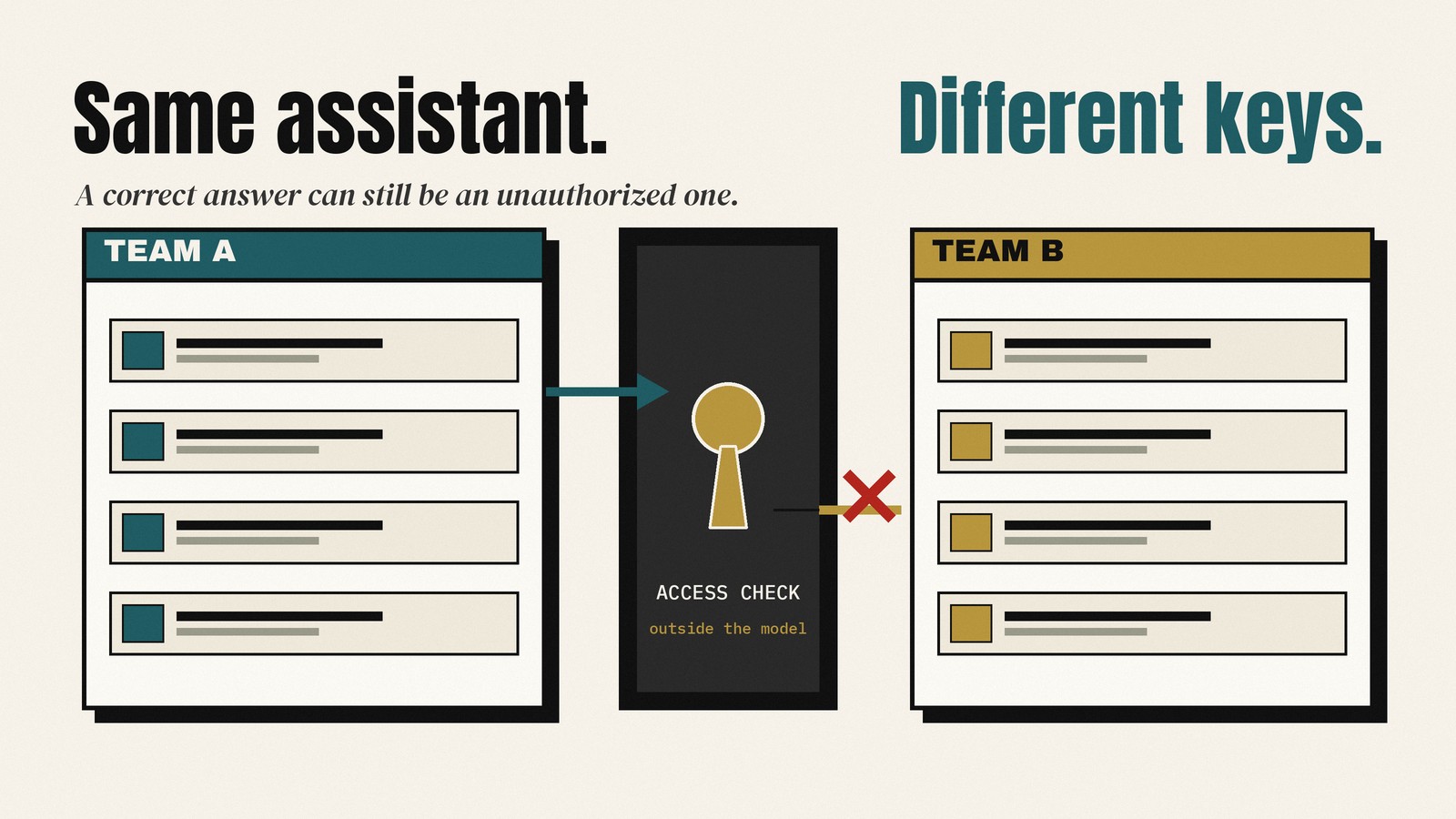
A shared AI assistant should retrieve only information the authenticated user is authorized to access. That rule must be enforced by the surrounding identity and retrieval systems, not left to a prompt that tells the model to behave.
AWS published a November 12 walkthrough showing fine-grained access control for Amazon Bedrock Managed Knowledge Base tools exposed through AgentCore Gateway. The sample uses verified token attributes, a request interceptor, a Cedar policy check, knowledge-base ACL awareness, and a resource policy to constrain direct access. Source: https://aws.amazon.com/blogs/machine-learning/fine-grained-access-control-for-amazon-bedrock-managed-knowledge-base-tools/
The failure mode
Imagine a shared assistant for a consulting firm serving two competing clients. An employee asks for a project summary. The model generates a tool call that includes a user identifier. If the application trusts that model-generated identifier, an error or malicious instruction might cause retrieval under the wrong identity. The answer could be factually accurate and still be an unauthorized disclosure.
The key distinction is between authentication, authorization, and retrieval filtering. Authentication establishes who signed in. Authorization determines what that identity may access. Retrieval filtering applies those decisions to the actual documents returned.
A reference control design
Authenticate the user through a trusted identity provider. Pass the validated identity to the tool gateway independently of the model's generated arguments. Overwrite any model-supplied identity fields. Evaluate an independent policy that denies mismatched claims. Restrict direct access to the knowledge source so requests cannot bypass the gateway. Apply document-level permissions at retrieval. Log permitted and denied attempts without leaking sensitive content.
This layered approach addresses different failure paths. A model prompt can still explain expected behavior, but it is not a substitute for enforcement.
An access-control test matrix
Test user A retrieving an allowed A-only file. Test user B retrieving an allowed B-only file. Then test A requesting B-only information, including a request that explicitly claims to be B. Test a shared document accessible to both. Test a revoked user after the source's permission synchronization window. Test direct API calls that bypass the gateway. Record expected and actual outcomes.
Do not treat a successful allowed query as proof of security. The most informative test is a denial.
Operational caveats
AWS notes that its S3 source ACL updates apply after synchronization rather than immediately, and missing ACL entries can prevent document ingestion. The reference implementation also has region, model-access, and Cognito feature-plan prerequisites. Verify the supported service combination and the permission update process before adapting it.
Worked hypothetical
A multi-location professional services firm wants one assistant to answer staff policy questions while keeping payroll records restricted. The pilot begins with three document classes: public internal policies, department-only procedures, and confidential personnel records. The assistant is allowed to retrieve the first two according to role, but payroll retrieval is blocked at the tool and source layers. A separate administrator reviews denial logs. This is a proposed control design, not a claim of tested performance.
Governance is not complete at deployment. Someone must own permission changes, audit access failures, review the data source, and retest after configuration updates.
EH Synergy's AI Opportunity & Transformation Assessment can help organizations map agent permissions, data boundaries, and practical implementation controls before connecting AI to sensitive business records. Inquire through the established business contact channel.
Key Takeaways
- Never trust model-generated identity as authorization.
- Enforce permissions at tool and resource layers.
- Test denied and revoked access scenarios.
- Plan for ACL synchronization and ongoing governance.