
AI Agent Identity and Delegated Access: An Implementation Checklist
By Erin Harris, AI Strategy & Business Transformation Consultant
An AI agent acting on behalf of a user needs a distinct agent identity, a verifiable delegation from that user, narrowly scoped resource permissions, and an audit trail that records both actors. A shared service account is rarely enough to answer who authorized a specific action.
A November 6 AWS technical walkthrough demonstrates this pattern with Okta Cross App Access and Amazon Bedrock AgentCore Identity. It uses short-lived delegated grants and tokens, with checks at the agent and tool layers. AWS reports that removing a user's assignment blocked new requests within about one second in its tests, but previously issued tokens could remain valid for up to five minutes. The authors explicitly describe the code as nonproduction sample material. Source: https://aws.amazon.com/blogs/machine-learning/govern-ai-agent-access-with-okta-cross-app-access-and-amazon-bedrock-agentcore-part-1/
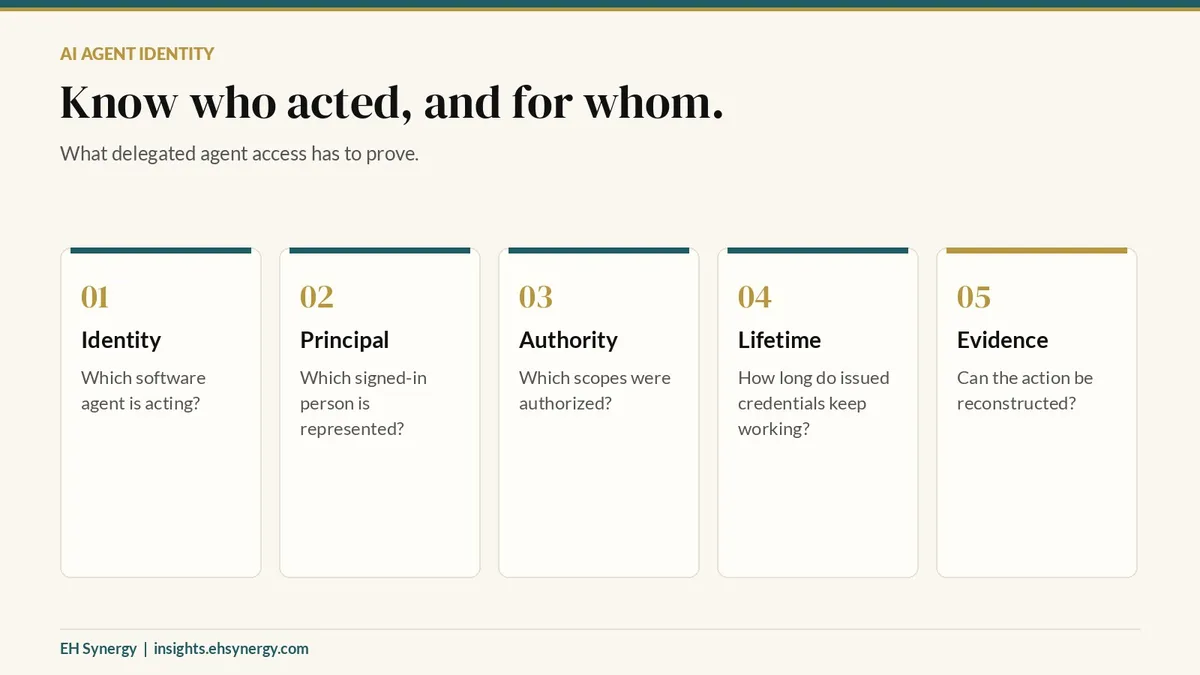
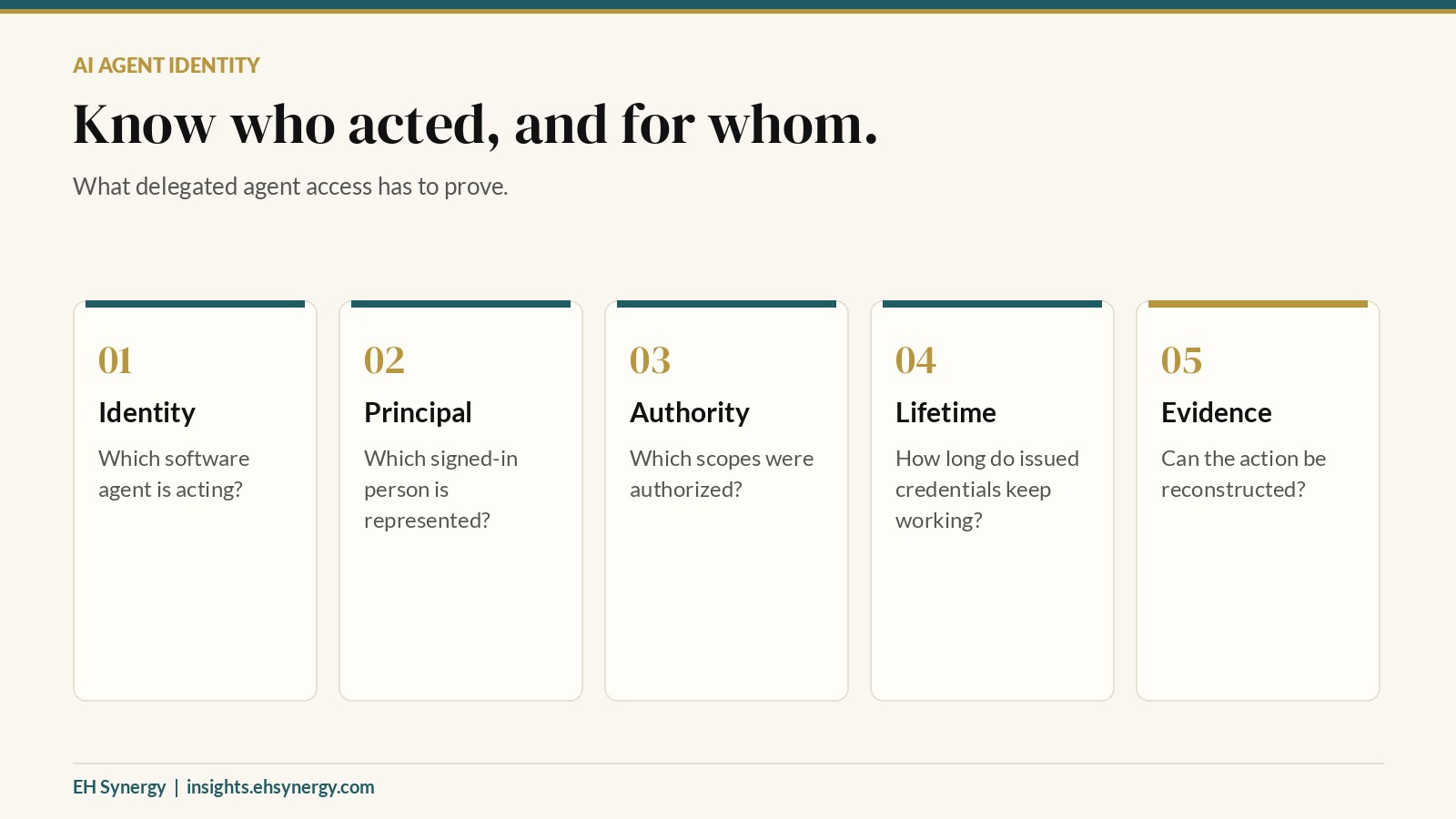
What Delegated Agent Access Must Prove
- Identity: Which software agent is acting?
- Principal: Which signed-in person is represented?
- Authority: Which application and scopes did an administrator and user authorize?
- Enforcement: Does the target tool independently reject unauthorized operations?
- Lifetime: How long can existing credentials continue to work after a permission change?
- Evidence: Can an investigator reconstruct the action without guessing?
The Implementation Checklist
- Create an inventory of agents, owners, connected applications and actions.
- Distinguish read, write, export and financial permissions; avoid broad catchall scopes.
- Register agents as identifiable workloads instead of reusing an employee's credential.
- Require delegated grants tied to a specific user and intended resource.
- Use short-lived tokens and a managed credential store; do not expose secrets to model prompts.
- Enforce authorization at every MCP server or business tool, even after gateway authentication.
- Log agent ID, user ID, resource, scope, tool, decision and time in a correlated audit trail.
- Test user removal, agent deactivation, revoked application connection, expired token and replay attempts.
- Define emergency controls for high-risk actions that do not depend solely on routine account deactivation.
- Reassess access whenever employees change roles, vendors leave, or an agent gains new tools.
A Revocation Test That Leaders Can Understand
Suppose an assistant can update a CRM record for a sales employee. First confirm that the employee can edit only assigned records. Next have the agent attempt an unauthorized record. The resource should reject it. Remove the employee's agent assignment and immediately repeat the request. Record whether new grants are denied. Then attempt a call with an already-issued credential and record when it expires. Finally inspect whether the logs show both the agent and the represented employee.
This is a hypothetical test plan, not a claim that a particular CRM or identity provider behaves in a specific way. It makes the difference between policy intent and actual enforcement observable.
Architectural Tradeoffs
Delegation can reduce credential sharing and improve traceability, but it adds integration work, policy design, token exchange, latency and operational dependencies. AWS reported approximately 0.6 seconds of AgentCore Identity overhead in one roughly 30-second test request. That is a single environment-specific measurement, not a general latency guarantee. The same report noted an 86-minute queue for one agent deactivation test. Both are reasons to test operational behavior before rollout.
What Not to Do
Do not grant an agent blanket administrator rights because it performs several tasks. Do not treat a prompt instruction as access control. Do not assume a dashboard's 'disabled' label proves that all outstanding tokens have expired. Do not publish sample code into production without a security review.
Key Takeaways
- Identity must bind the agent and the represented user.
- Revocation latency is measurable and operationally important.
- Short-lived tokens reduce exposure but do not erase it.
- Resource-side enforcement and audit trails are essential.
Organizations preparing to connect AI agents to customer or financial systems can inquire about an AI Opportunity & Transformation Assessment through EH Synergy's existing contact channel to prioritize workflows and governance controls.
About the Author
Erin Harris is an educator, AI strategy consultant, and business owner with an MBA in Marketing and a Master of Education (M.Ed.) in Educational/Instructional Technology, Western Governors University.