
AI Cost Attribution and Budget Controls: What Business Leaders Should Know
AWS's October 30 guidance shows why a spending report is only useful when the organization can identify what caused the charges.
By Erin Harris, AI Strategy & Business Transformation Consultant
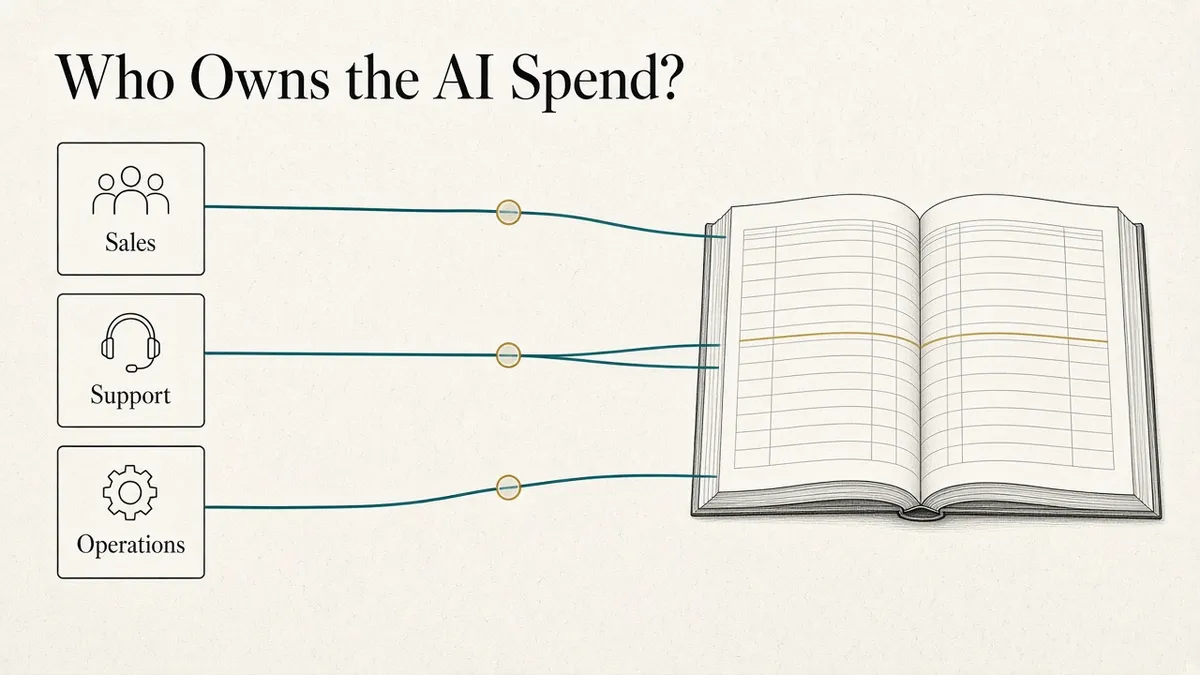
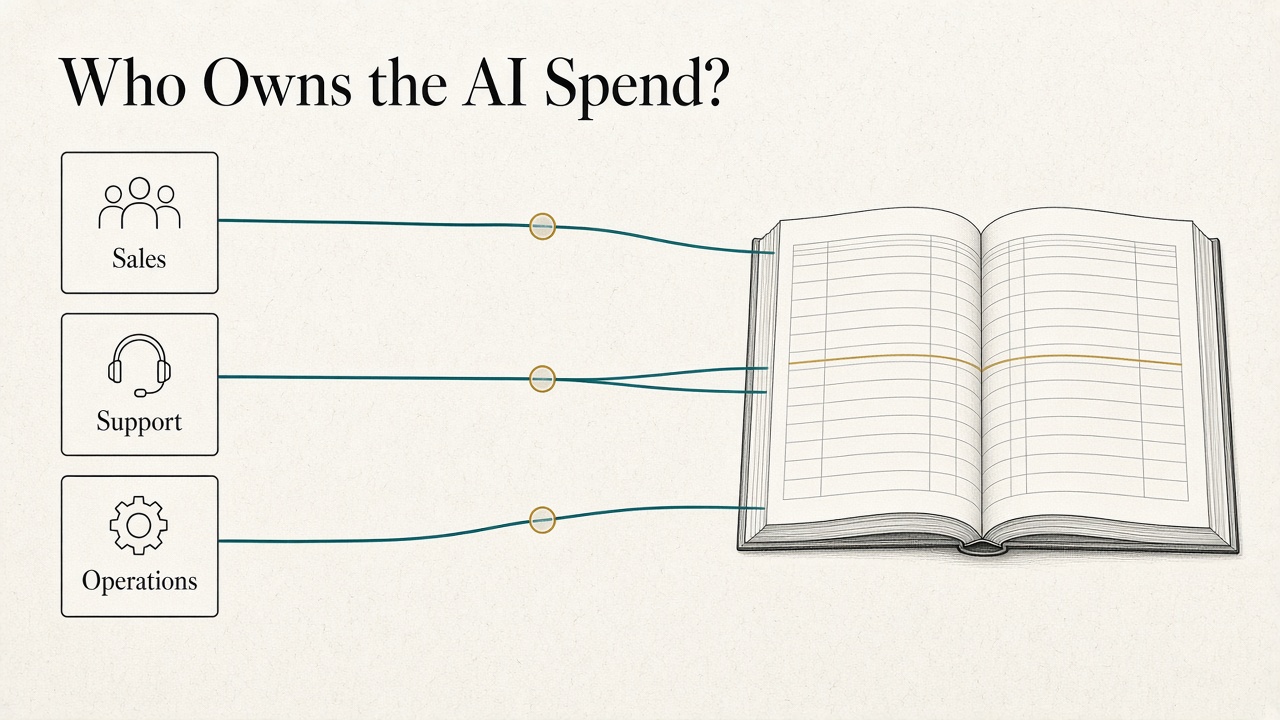
AI cost governance starts with three questions: who generated the spending, which business workflow was responsible, and what happens when that workflow approaches its approved limit?
On October 30, 2026, Amazon Web Services published a technical playbook for managing Amazon Bedrock costs. It describes five operating stages: attribution, observation, budget enforcement, optimization, and recurring review. The recommendations apply to AWS environments, but they provide a useful framework for leaders evaluating connected AI assistants and agents. Source: https://aws.amazon.com/blogs/machine-learning/managing-amazon-bedrock-costs-end-to-end-a-playbook-for-finops-and-platform-teams/
The new contribution is not another comparison of model prices. It is a practical account of the controls an organization needs after multiple teams begin using AI through shared systems.
1. Identify the owner before trying to optimize spending
A company might deploy an AI lead assistant, an internal knowledge assistant, and an employee coding tool. If each system has a clear owner and separate usage metadata, its spending can be reviewed against a business objective. If requests are pooled under one shared account, the total may be visible while the underlying activity is not.
AWS calls out a particular version of this issue. A gateway that invokes Amazon Bedrock using one IAM role can make all charges appear under that shared role. Its guide describes session tagging and other attribution options to recover more specific identity and application information.
This is not a reason for every business to adopt complex cloud infrastructure. It is a reason to ask the provider or implementation team what the monthly report can actually identify.
A useful ownership record contains: workflow name, business sponsor, technical owner, expected task, authorized data, spending limit, and review frequency.
2. Record the request context that makes charges meaningful
A billing total alone cannot tell a business whether its AI usage was productive. The next layer is observability: request logging and consistent metadata that explain which feature or workflow produced the activity.
AWS describes model invocation logging and metadata such as application, workflow, and agent. It also notes that metadata consistency requires deliberate implementation. Teams cannot assume every application will label requests the same way.
Consider a hypothetical appointment assistant. A customer asks for availability. The system looks up a calendar, drafts a response, and perhaps retries when an integration fails. A useful record distinguishes the initial request from the retry and identifies whether the appointment was actually confirmed.
That example is illustrative, not a client result. Its value is in the measurement design: business outcome, total calls, exceptions, and owner.
3. Choose the kind of budget control you actually need
AWS describes three tiers of spending control. They answer different questions.
- Monitor and alert: the organization receives a warning when a threshold is reached. It is simple but does not automatically stop further charges.
- Asynchronous enforcement: an automated process can deny access after a threshold, but the block may not be immediate.
- Synchronous gateway enforcement: requests pass through a control point that can block spending at the threshold. This is stronger but requires additional infrastructure and security review.
The appropriate choice depends on how quickly spending can accumulate and how disruptive a hard stop would be.
For example, stopping a test environment may be acceptable. Automatically blocking a customer-facing assistant during a busy service period could create a different operational problem. Controls should include an exception and escalation plan, not just a dollar figure.
4. Optimize only after defining acceptable quality
Model routing, caching, and token limits can reduce consumption. AWS includes these among its platform optimization levers. But reducing cost without measuring quality can create more retries, additional employee review, or poorer customer experiences.
The responsible sequence is to establish a baseline, test a lower-cost configuration on representative tasks, compare results, and keep the change only if it meets the same quality standard.
An inexpensive response that requires manual correction is not automatically a bargain. Equally, an expensive response may be justified when it safely resolves a high-value task.
5. Establish a recurring review
A practical AI cost review does not need to become a lengthy executive meeting. It should make decisions possible.
Key Takeaways
- Attribute AI spending to a named workflow and accountable owner.
- Capture enough usage context to distinguish routine work from retries and errors.
- Understand that alerts, delayed blocks, and immediate enforcement are different controls.
- Evaluate quality before changing models or routing rules.
- Review spending alongside actual business outcomes.
A five-field AI spending review worksheet
For each AI workflow, document the following:
- Field 1: Owner and purpose. Who approved the workflow, and what task should it complete?
- Field 2: Usage source. Which platform, application, or team generated the billable activity?
- Field 3: Quality and exceptions. How many tasks succeeded, failed, retried, or needed human intervention?
- Field 4: Budget response. Is there an alert, an enforced stop, or a documented human escalation?
- Field 5: Decision. Should the organization continue, redesign, limit, or retire this workflow?
This worksheet is an EH Synergy editorial framework, not an AWS product feature or a substitute for technical configuration.
What the AWS guidance does not prove
The publication is a technical how-to, not a controlled study of customer savings. Its examples and scorecard thresholds are not universal benchmarks. AWS model availability, API compatibility, region support, and costs vary by environment. Implementing logging also creates privacy and data-retention responsibilities.
A business using another AI platform can borrow the governance questions without assuming AWS-specific controls are available there.
The business decision behind the technical controls
AI cost attribution is ultimately about decision rights. When no one owns a workflow, no one is well positioned to explain its spending, assess its performance, or decide when it should stop.
For organizations evaluating connected AI tools, an AI Opportunity & Transformation Assessment can help identify which workflows deserve investment and what operational controls should accompany them. Learn more about EH Synergy and its business systems work at https://www.ehsynergy.com/.
Sources and verification: AWS, "Managing Amazon Bedrock costs end to end," October 30, 2026: https://aws.amazon.com/blogs/machine-learning/managing-amazon-bedrock-costs-end-to-end-a-playbook-for-finops-and-platform-teams/. AWS implementation guidance is attributed to AWS. Examples and the five-field worksheet are illustrative editorial frameworks, not documented customer outcomes.