
AI-Enabled Cyber Threats and Business Workflows: What Leaders Should Review
Google's October 30 investigation highlights why access controls and response ownership deserve attention as businesses connect more systems to automation.
By Erin Harris, AI Strategy & Business Transformation Consultant
Businesses evaluating AI agents and connected workflows should review three operational questions with their technology and security teams: which systems can be accessed, how unusual activity will be detected, and who can interrupt a risky process.
These questions are not a substitute for cybersecurity expertise. They are management responsibilities that become more important as automation gains access to customer records, administrative tools, and business applications.
On October 30, 2026, Google Threat Intelligence Group and Mandiant published an investigation into the observed use of AI-driven offensive frameworks in real intrusions. The researchers describe frameworks including ARTEX, PentAGI, and CAIRN, and report seeing agentic activity across parts of the attack lifecycle in engagements dating back to late August. Some observed actions occurred in rapid bursts, while the report also notes that many operations remain noisy and relatively unsophisticated.
The business lesson is not that every AI agent is dangerous. It is that attackers can automate the testing of familiar weaknesses, which can reduce the time available for defenders to intervene.
What the research actually shows
Google and Mandiant describe threat actors using agentic tools to assist with reconnaissance, permission testing, and movement through compromised environments. The report includes specific incident observations, including a campaign where an attacker reportedly reached deep system access in around four hours and once in 15 minutes.
Those numbers should not be presented as average attack times. They describe particular observed cases, not a universal rate.
The researchers also emphasize that the underlying techniques often remain familiar: compromised identities, overbroad permissions, vulnerable configurations, and misuse of legitimate administrative functions. Automation increases the speed at which those opportunities can be explored.
This is separate from the question of whether a company's own AI assistant is behaving correctly. External attacker automation and internal agent governance overlap in the systems they touch, but they are different security problems.
Why connected business workflows deserve a review
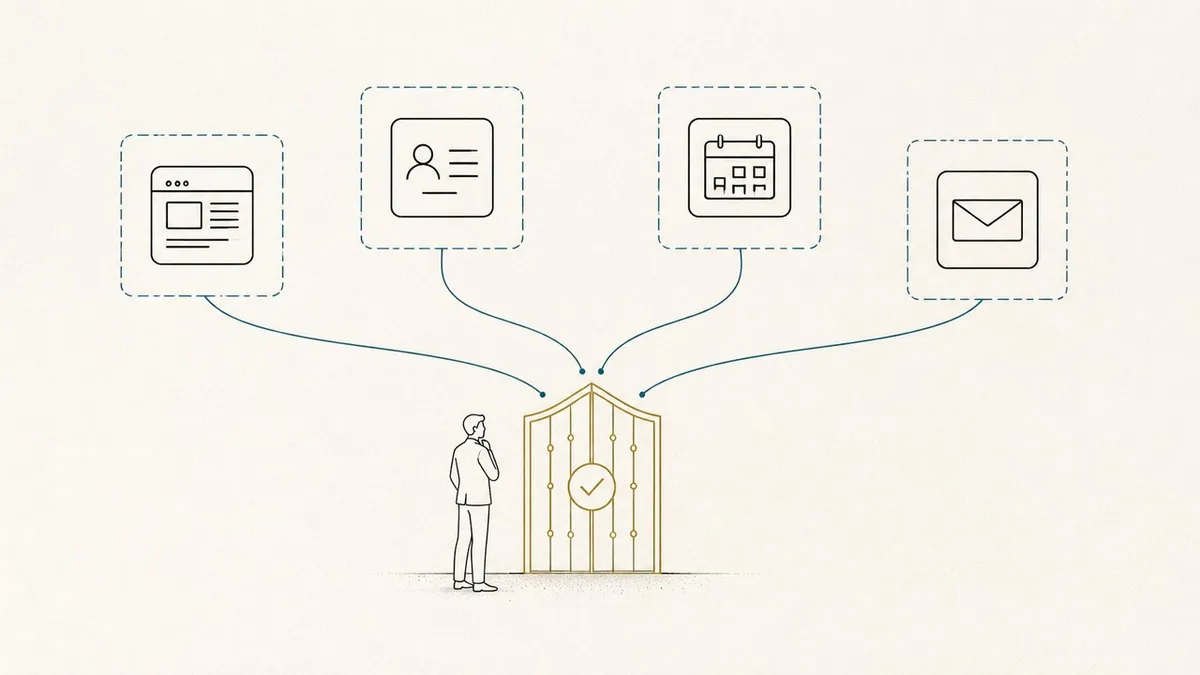
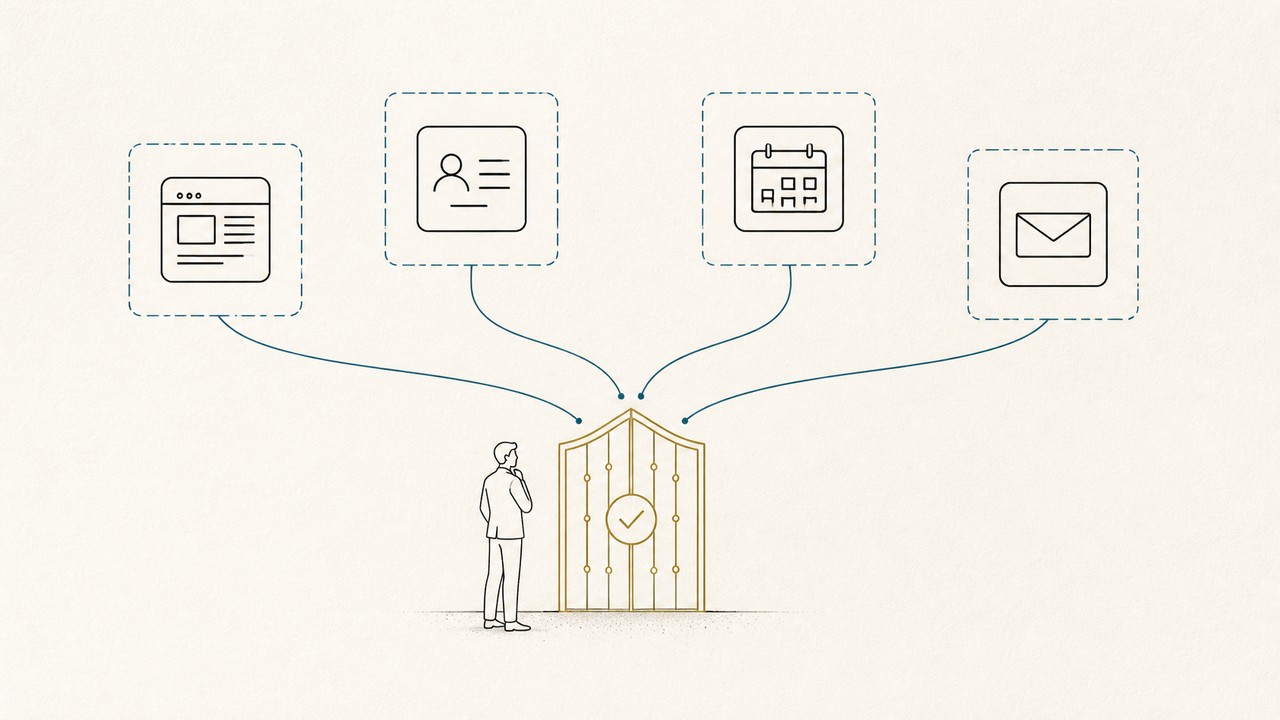
Consider a hypothetical service business that connects a website form, CRM, calendar, email platform, and payment processor. Automation may improve lead follow-up and appointment management.
Each connection also creates a permission decision. Does the automation need to read customer details, edit records, send messages, issue refunds, or administer the account? A system that only needs to create a lead should not automatically receive full administrative access.
The example is illustrative, not a claim that a specific company was compromised through such a workflow.
A business leader does not need to configure identity controls personally. The leader should know who approved the connections, which provider manages them, and how access can be revoked when an integration is no longer needed.
Five questions for the technology and security review
- Who owns each connected system? Name the responsible person or provider for the website, CRM, integrations, cloud infrastructure, and administrative accounts.
- Which identities have high-impact access? Ask the security provider to review privileged users, service accounts, API credentials, and automation identities, including access that is no longer necessary.
- What restrictions exist? Verify whether appropriate multifactor authentication, least-privilege permissions, limited credential lifetimes, and protected administrative access are in place. Technical suitability varies by platform.
- What unusual activity would be noticed? Ask how the provider detects unexpected login patterns, rapid API activity, unusual exports, or configuration changes, and whether alerts are actually reviewed.
- Who can intervene? Identify the escalation contact, decision authority, and process for disabling access or containing suspicious activity.
This is an executive discussion checklist. Security professionals should determine the actual technical controls, testing, and incident response procedures.
Key Takeaways
- Google's report documents specific observed uses of agentic offensive frameworks, not a universal attack pattern.
- Automated attackers can move quickly through existing credential and permission weaknesses.
- Business automations need defined owners and only the access necessary for their work.
- Monitoring is useful only when someone can interpret alerts and respond.
- Security configuration and incident response belong with qualified specialists.
The tradeoff between convenience and control
Connected systems are useful because they reduce manual handoffs. An inquiry can move from a website into a CRM, trigger a follow-up, and offer a booking without requiring employees to copy information between tools.
The more connected the workflow, however, the more important it becomes to understand what each integration can do.
Too much restriction can break legitimate operations. Too little can expose sensitive information or permit changes outside the intended scope. Additional logging may also introduce costs and privacy obligations.
A responsible design balances these concerns through risk-based permissions, testing, ownership, and review. It does not assume that one set of controls fits every business.
Google and Mandiant recommend established defenses such as protecting administrative control planes, using more limited and short-lived credentials, hardening configurations, and detecting unusual behavior. The report is a threat-intelligence analysis, not a guarantee that any one control prevents every incident.
Where an AI workflow assessment fits
An AI Opportunity & Transformation Assessment can help map the operational side of a business workflow: what triggers it, which systems it touches, who owns it, and which actions should require approval.
That assessment should not be mistaken for a penetration test, vulnerability scan, incident response engagement, or cybersecurity certification. Businesses needing those services should engage qualified security providers.
For organizations planning CRM, website, and AI integrations, the practical first step is to document the system connections and bring the appropriate technology and security stakeholders into the discussion before granting broad permissions.
Learn about EH Synergy's business systems work at https://www.ehsynergy.com/.
A more useful response to the headline
The October 30 report provides evidence that some attackers are already using agentic frameworks in real operations. It does not establish the prevalence of those tools across all attacks, nor prove when fully autonomous attacks will become common.
For business leaders, the responsible response is not to speculate about a dramatic future. It is to review the systems and permissions already in place, understand who watches them, and make sure the organization can act when something changes.
Source and limitations: Google Threat Intelligence Group and Mandiant, "ARTEX and Friends: Enter Agentic Offensive Frameworks," October 30, 2026: https://cloud.google.com/blog/topics/threat-intelligence/artex-and-friends-enter-agentic-offensive-frameworks. All incident details are attributed to the researchers. Business checklist and workflow example are editorial applications, not claims of EH Synergy cybersecurity services.