
Reviewing AI-Generated Access Policies: A Semantic Difference Checklist
By Erin Harris, AI Strategy & Business Transformation Consultant
When AI generates an authorization policy, a normal text diff is not enough to establish that the policy preserves the original requirement. Teams need to compare actual permission behavior, not just the words or syntax. A practical review combines a written requirement, independent policy candidates, semantic comparison, counterexamples, validation and accountable approval.
On November 11, 2026, AWS researchers published a technical walkthrough of semantic diffing using an open-source anti-unification engine. The approach identifies common structure and marks disagreements between formal expressions while ignoring differences justified by declared algebra and rewrite rules. It does not independently determine the correct policy, nor does it automatically validate every native policy format. Source: https://aws.amazon.com/blogs/machine-learning/semantic-diffing-of-formal-policies-with-anti-unification/
Why ordinary review misses the risk
A policy may rearrange its conditions without changing meaning. A textual comparison can overemphasize those changes. At the same time, replacing AND with OR or dropping a path restriction may substantially widen what a system permits. The highest-risk discrepancy can be visually small.
For an AI agent, these distinctions are operational. A rule may govern file access, tool calls, network destinations, approval gates or actions on customer data. An error in the rule can turn an otherwise controlled agent into one that acts beyond its intended scope.
The five-check review protocol
- Write the requirement before generating policy code. Identify the principal, action, resource, permitted context, required approvals and explicit denials.
- Produce independent candidate formalizations. A second draft is useful for surfacing ambiguity, not for proving the first is correct.
- Compare candidates under justified equivalence rules. Record every algebraic identity and domain rewrite; do not silently assume that different expressions are interchangeable.
- Resolve meaningful disagreements using schema validation, counterexamples, test inputs and policy replay where supported. Ask which specific request one candidate permits and the other denies.
- Require sign-off from the policy owner. Record the final version, tested cases, unresolved limitations and deployment change history.
Worked hypothetical example
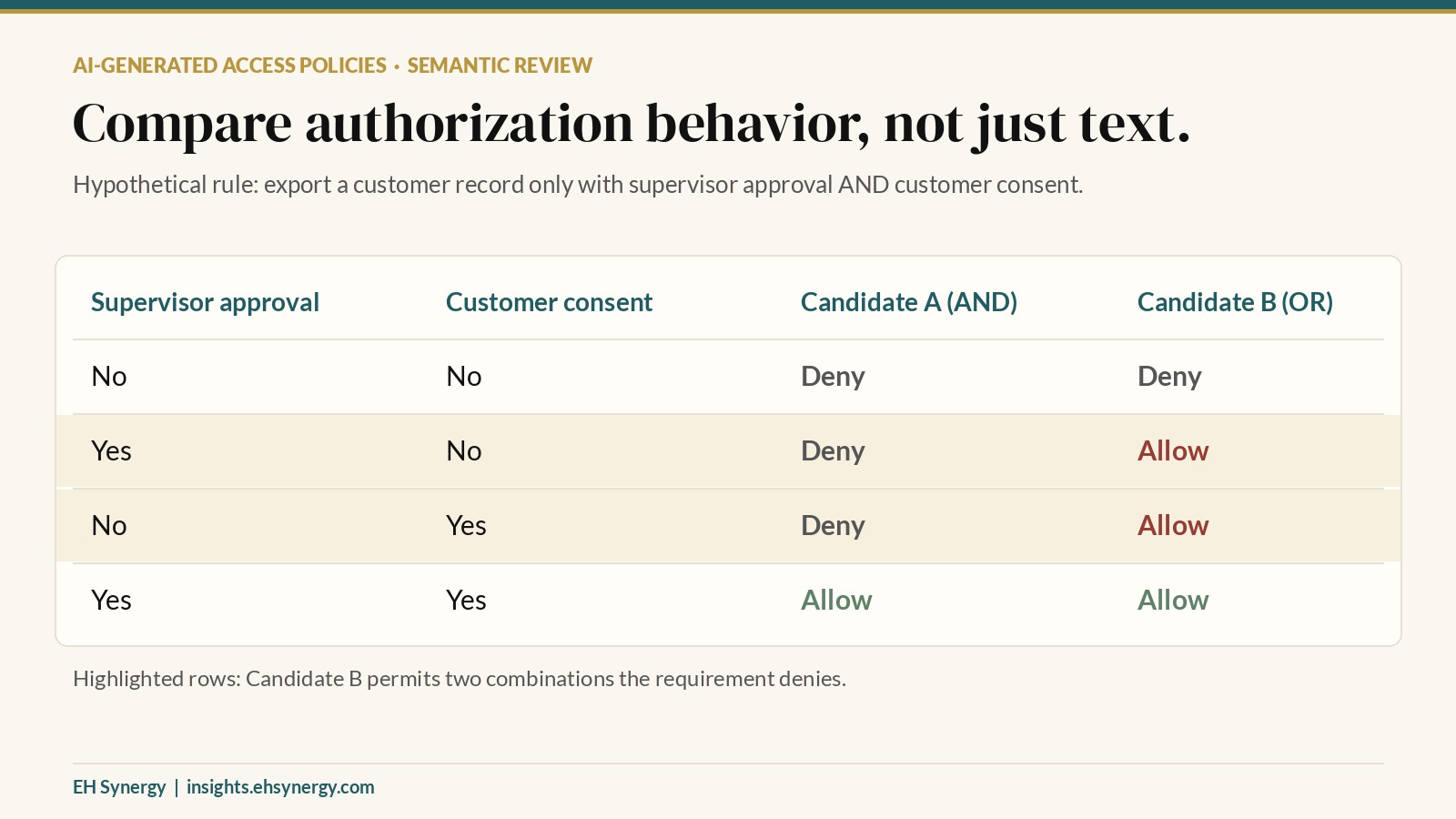
A business requirement says a support agent may export a customer's records only when a supervisor approves the export AND the customer consents. Candidate A requires both conditions. Candidate B permits the export if either condition is present.
Test the four combinations: neither condition, approval only, consent only, and both conditions. Candidate A permits only the final combination. Candidate B also permits the two middle combinations. That discrepancy exposes a widened authorization rule without requiring anyone to interpret a long source file. This is a hypothetical example, not a claim about a deployed AWS customer.
What the semantic engine contributes
The AWS approach can collapse equivalent expressions and localize the parts that remain different. That is useful when independent policy translations use different ordering, grouping or domain vocabulary. In the research examples, a missing guard and a changed threshold become more visible after cosmetic differences are removed.
But a tool cannot infer the business owner's intent from two candidates alone. If both versions omit a safeguard, their agreement is misleading. If a rewrite rule is unsound, the comparison may hide a difference. And the engine works on encodings of formal expressions, not as a universal importer and verifier for all policy languages.
Deployment safeguards
Treat policy comparison as one stage in a larger change-control process. Validate the native policy syntax and schema, run representative allow and deny tests, include edge cases, preserve a rollback path and monitor real authorization decisions. Separate the person proposing the policy from the person approving a consequential expansion of access.
When to use this approach
Semantic diffing is most useful when AI generates complex policies or when policy revisions contain many cosmetic changes. A simple manual decision table may be enough for a short rule. The objective is not to add technical ceremony. It is to expose meaningful differences early enough that the organization can make an informed decision.
Key Takeaways
- Compare authorization behavior, not just text.
- Test the effect of AND, OR, thresholds and missing guards.
- Declare and validate every equivalence assumption.
- Use counterexamples to resolve disagreements.
- Preserve accountable human approval for final policy behavior.
AI Opportunity & Transformation Assessment
If your organization is considering AI agents with access to operational systems, inquire with EH Synergy about an AI Opportunity & Transformation Assessment. The first question is which actions the business can safely delegate, not which agent is easiest to install.