
Using AI for Military-to-Civilian Career Transition: A Verified Skills Workflow
By Erin Harris, AI Strategy & Business Transformation Consultant
Practical guidance for workforce programs, employers, and career-support teams.
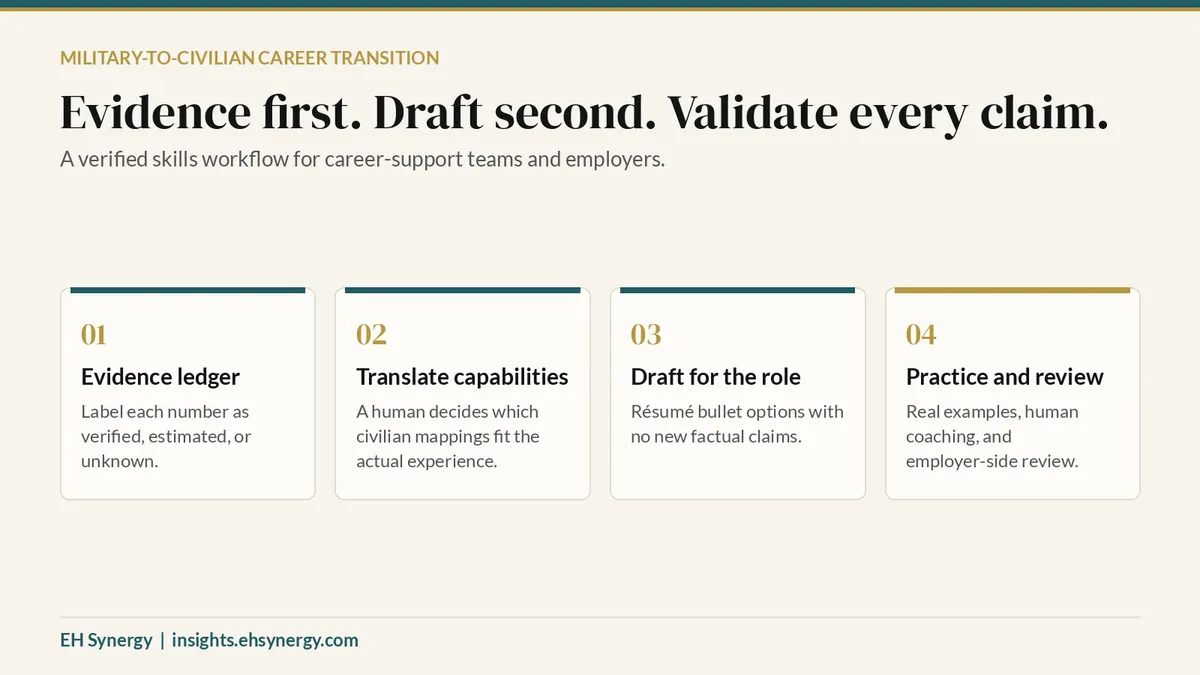
AI can support military-to-civilian career transitions by translating documented experience into language employers recognize. A responsible process collects evidence first, drafts second, and validates every claim before the application is sent.
On November 11, 2026, OpenAI reported that more than 20,000 veterans and transitioning servicemembers had claimed a free year of ChatGPT Plus during the prior year. Academy and partner training reached nearly 1,000 military-community participants through more than a dozen events. These are participation figures, not evidence that AI caused successful job placements. Source: https://openai.com/index/chatgpt-plus-for-veterans/
Start With an Evidence Ledger
Before asking AI to draft a résumé, capture actual duties, decisions, systems, stakeholders, and results. Label each number as verified, estimated, or unknown. Do not allow the model to invent cost savings, team sizes, or awards.
Translate Capabilities, Not Just Titles
A military logistics role may include inventory control, scheduling, safety compliance, vendor coordination, and incident response. A tool can help map these to civilian operations terminology, but a human must decide which mappings fit the actual experience and target job.
Draft for the Specific Role
Provide a job description and the verified evidence ledger. Ask for a small set of résumé bullet options with no new factual claims. Review for military-sensitive information, exaggerated equivalence, misleading credentials, and keyword stuffing. The candidate must own every sentence.
Practice the Interview
Generate behavioral questions tied to the role. Have the candidate answer aloud using real examples, then seek feedback from a career advisor or experienced hiring professional. A coherent narrative is more valuable than memorized AI phrasing.
Worked Hypothetical Example
A former unit supply coordinator applies for a distribution supervisor opening. AI suggests a bullet about coordinating inventory and cross-functional schedules. The candidate verifies the scope, deletes an unsupported percentage, and explains the decision process during a mock interview. The workflow improves clarity, but it does not guarantee an interview or offer.
Employer-Side Review
Employers should evaluate whether their job descriptions unnecessarily exclude transferable experience. Structured, evidence-based interviews can reduce reliance on jargon. Automated screening must not silently become the final authority on a candidate's credibility.
Data and Access Safeguards
Do not enter private identifiers, protected service records, or classified or sensitive information into unapproved tools. Confirm current eligibility for any free-access program rather than assuming it applies to all veterans. Track interview invitations, application quality, and placements separately from subscriptions claimed.
Key Takeaways
- Collect verified evidence before drafting.
- Use AI for language translation, not achievement invention.
- Combine candidate review, human coaching, and employer-side assessment.
- Measure career outcomes rather than tool adoption alone.
EH Synergy offers an AI Opportunity & Transformation Assessment for organizations evaluating responsible AI workflows and training. Inquire through established EH Synergy contact channels to discuss implementation priorities.