
Amazon Bedrock AgentCore Web Search API: Choosing the Right Retrieval Architecture
By Erin Harris, AI Strategy & Business Transformation Consultant
AWS announced a direct Web Search API for Amazon Bedrock AgentCore on November 11, 2026. The practical change is straightforward: applications can invoke web search with AWS credentials without first creating an AgentCore Gateway. For organizations building assistants that need current information, this can reduce setup complexity. It does not eliminate source verification, authorization design or answer-quality testing.
What changed
The InvokeWebSearch operation accepts a search query and supports publication-date and domain filtering. AWS says it returns ranked results with extracts and available metadata such as URL, title and publication time. Requests are signed with AWS Signature Version 4, and IAM authorizes access. AWS lists six supported regions at launch and a price of $7 per 1,000 queries. Verify current region availability, quotas and pricing before implementation. Official source: https://aws.amazon.com/blogs/machine-learning/introducing-the-web-search-api-on-amazon-bedrock-agentcore/
Direct API versus Gateway
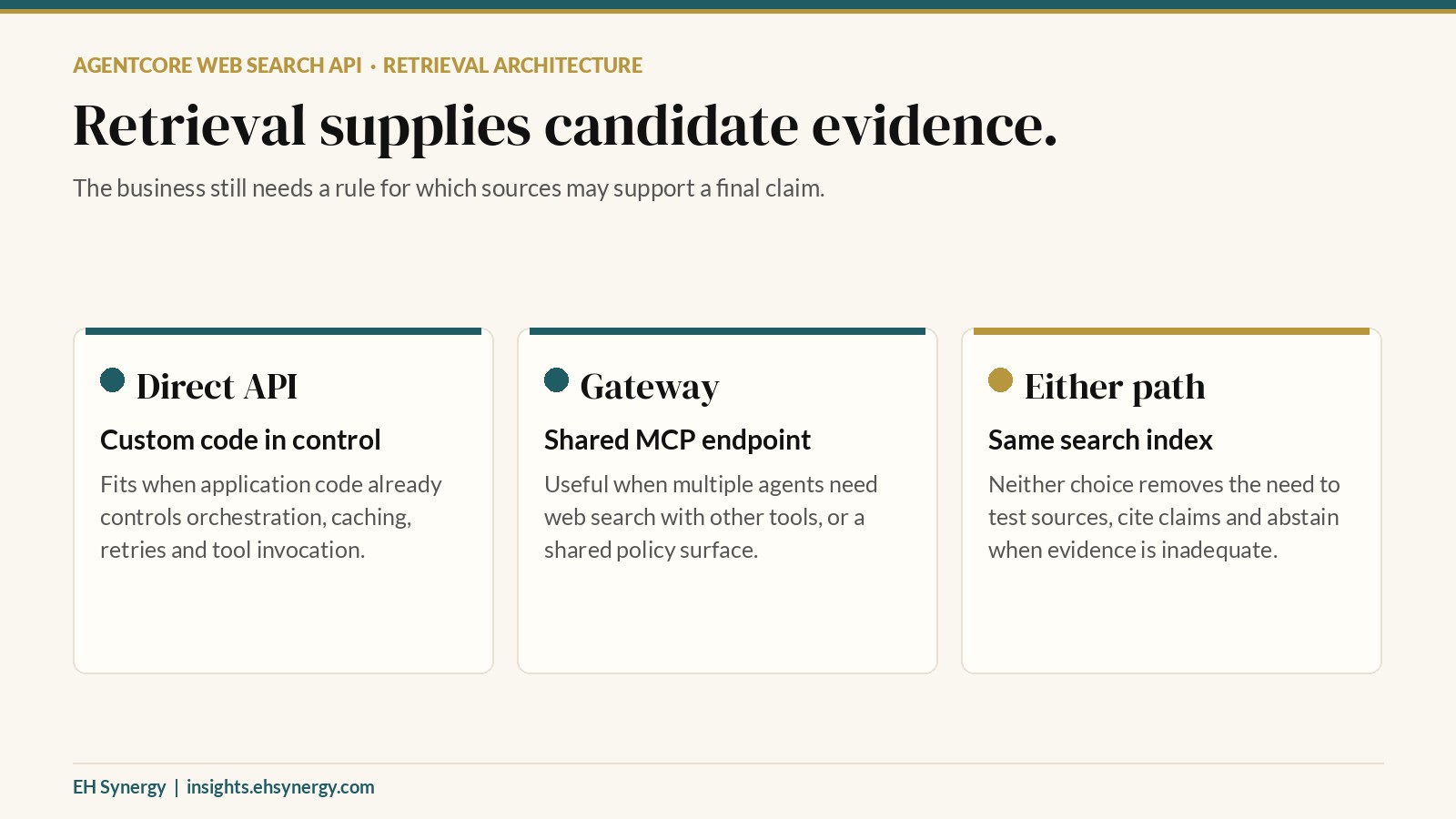
The direct API is a fit when custom application code already controls orchestration, caching, retries and tool invocation. It can also serve non-agent pipelines and dashboards. The Gateway remains useful when multiple agents need an MCP endpoint combining web search with other tools, or when administrators need a shared policy surface. AWS says both options use the same search index. They differ in how teams configure access and govern calls. Choosing the simpler integration is not always choosing the simpler operating model.
A practical acceptance test
Start with ten questions that reflect the assistant's real job. Include three with clear official answers, three that require recent dates, two where reputable sources disagree, and two where the available evidence is inadequate. Define what counts as an authoritative source before running the test. For each response, record the exact claim, cited URL, page date if available, and whether the retrieved text actually supports the claim.
Do not award full credit merely because a link appears. A result about an official policy can still be a secondary summary, and a recently published article can describe an outdated rule. Test whether the system distinguishes these cases. The expected behavior for unresolved conflicts should be explicit: request clarification, escalate or abstain.
Governance checklist
- Restrict IAM permissions to the roles that actually need web search.
- Decide which domains may be searched and which sources may support final claims.
- Treat missing publication dates as missing information, not evidence of recency.
- Log enough retrieval context to investigate incorrect answers while respecting data-handling rules.
- Evaluate search charges alongside model inference, development and ongoing review costs.
- Assign a human owner for high-impact claims and escalation rules.
- Retest when the source landscape or business policy changes.
Worked hypothetical example
A plumbing company's assistant answers whether a permit is required for a particular repair. It retrieves a forum discussion and a municipal code page. The forum post is newer, but the municipality is the relevant authority. The assistant should ground the permit claim in the official page and state any uncertainty about jurisdiction or the specific job. If no authoritative answer is available, it should route the question to a person rather than invent a definitive rule. This is a hypothetical scenario, not a tested customer implementation.
Where teams get this wrong
Teams sometimes treat retrieval as the final safety layer. In practice, retrieval supplies candidate evidence. The business still needs a rule for evaluating that evidence and deciding what the agent may say or do. Search filters can narrow exposure but cannot establish that a claim is true. A fast integration without an answer-quality benchmark is a launch risk.
Key Takeaways
- The direct API reduces infrastructure setup for custom search integrations.
- Gateway may remain preferable for shared MCP tools and centralized governance.
- Search-result metadata supports verification but does not replace it.
- Test conflicting and unanswerable questions before production.
- Confirm current pricing, regions and access requirements with AWS.
AI Opportunity & Transformation Assessment
If your organization needs to determine whether web-connected AI belongs in its operations, inquire with EH Synergy about an AI Opportunity & Transformation Assessment. The work should begin with the business decision and risk, not with a preferred vendor.