
Amazon Bedrock Cost Tracking by Team: IAM Tags, CUR 2.0 and Budget Controls
By Erin Harris, AI Strategy & Business Transformation Consultant
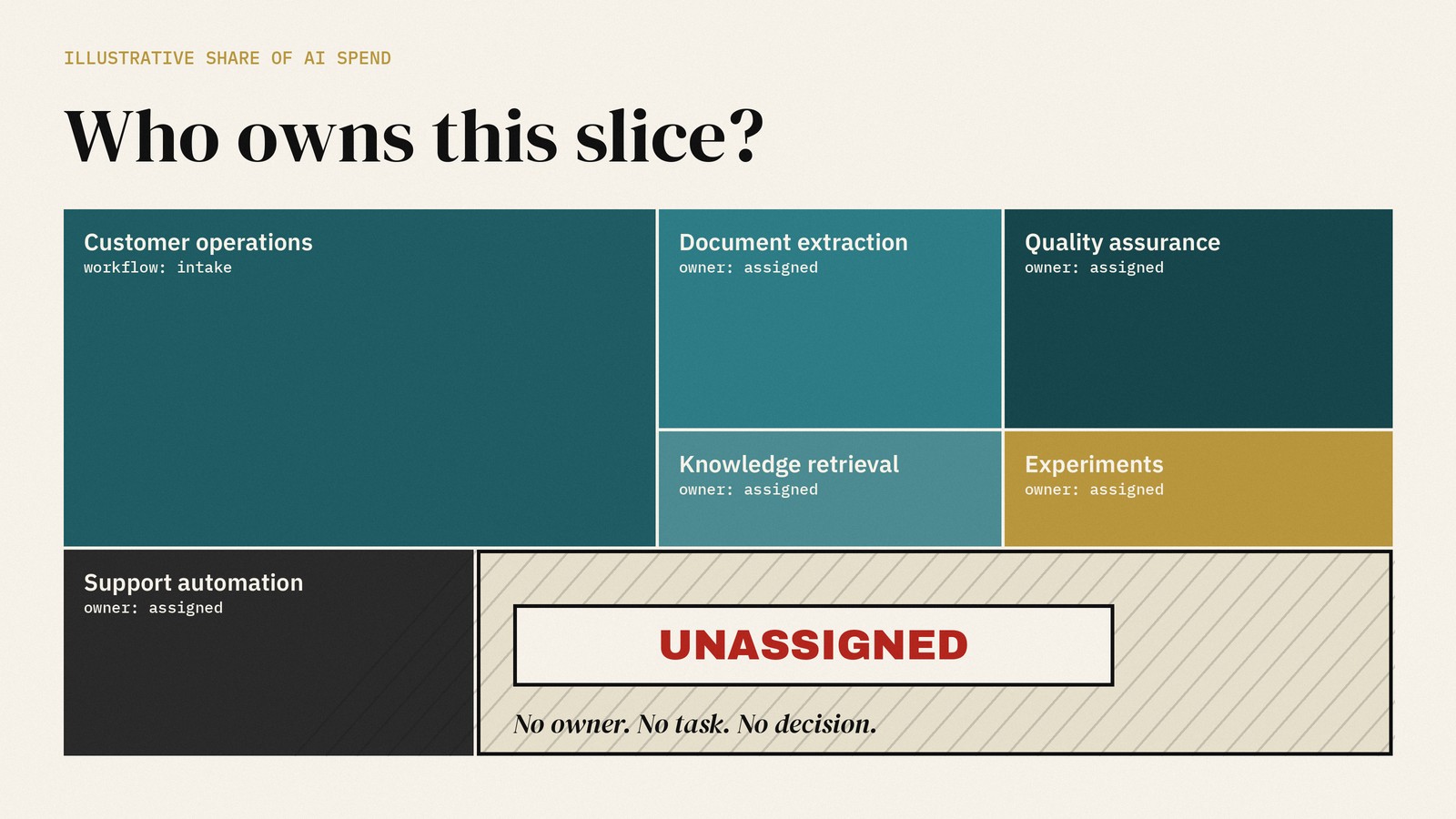
Amazon Bedrock cost governance starts with assigning each AI workload an accountable identity, then connecting usage data to the business task it performs. A budget limit can reduce uncontrolled spending, but it does not replace workflow-level ROI measurement or a continuity plan.
On November 12, 2026, AWS published a technical guide for tracking Bedrock inference spending by IAM principal and enforcing thresholds with AWS Budgets actions. It describes per-identity reporting using IAM principal or session tags, Cost Explorer or CUR 2.0, and budget actions that can attach a Deny policy. Source: https://aws.amazon.com/blogs/machine-learning/tokenomics-at-scale-track-and-cap-amazon-bedrock-spend-per-iam-principal-with-cur-2-0-and-aws-budgets/
This is relevant to organizations running Bedrock, not a universal procedure for every AI provider. It also has prerequisites: an AWS account with Bedrock access, appropriate IAM and billing permissions, and tag activation before useful allocation data is available.
What to measure before setting a budget
A monthly dollar ceiling is useful, but incomplete. First define the workload: customer intake, document extraction, knowledge retrieval, quality assurance, or another specific activity.
Then record the workload owner, baseline manual effort, model and infrastructure expenses, review and correction time, volume, success criteria, and the consequences of interruption.
Without that context, a cost reduction could simply reflect a failed service or fewer completed tasks.
A practical attribution architecture
AWS notes that Bedrock records IAM principal identity for inference requests. If each application has a distinct role, principal tags can associate spending with a workload or cost center. When a gateway or shared role serves multiple users, session tags may be required to preserve per-user attribution. Source: https://aws.amazon.com/blogs/machine-learning/tokenomics-at-scale-track-and-cap-amazon-bedrock-spend-per-iam-principal-with-cur-2-0-and-aws-budgets/
A company could define a consistent naming policy for business unit, workflow, environment, and owner. The names should be stable enough for reporting and specific enough to guide decisions.
For example, a hypothetical organization might use:
Team: Customer Operations
Workflow: Warranty Triage
Environment: Production
Owner: Support Operations Manager
These are example labels, not a claim about an AWS customer deployment.
The important design choice is to avoid one anonymous shared identity for every workload.
How to implement the controls
- Inventory current Bedrock callers. Identify each role, application, and team that can invoke a model. Confirm whether one role represents many users.
- Decide attribution granularity. Use a distinct role when appropriate. Where a shared role is necessary, review session-tag support and the identity provider's configuration. AWS notes that a role trust policy must allow sts:TagSession for session tags.
- Activate cost allocation tags. AWS says new tag keys may take up to 24 hours to appear for activation, followed by up to another 24 hours before data begins populating. Activation is not retroactive by default. Plan this before the reporting period. Source: https://aws.amazon.com/blogs/machine-learning/tokenomics-at-scale-track-and-cap-amazon-bedrock-spend-per-iam-principal-with-cur-2-0-and-aws-budgets/
- Choose the reporting layer. Cost Explorer can support console-based analysis. CUR 2.0 exports provide detailed line items and can be queried with Athena when more granular analysis is required. Confirm billing permissions and storage configuration.
- Establish thresholds by business impact. Create warning thresholds before restrictive actions. Decide whether the workload may stop, should degrade gracefully, or needs a manual alternative.
- Test a budget action. AWS describes applying a Deny policy when a budget threshold is reached. Validate who can approve the action, how it is reversed, and whether the service can tolerate an interruption.
- Review the task economics monthly. Compare spending against successful completed tasks and human correction effort. A falling bill is not proof of improved value.
The hard-stop trap
Imagine a customer support agent that consumes its planned monthly budget during a promotion. An automated Deny action may prevent further model calls. That protects against continued usage but can also interrupt legitimate customer work.
The organization needs an exception process and an alternate service path. Budget data and actions are not equivalent to instantaneous request-level throttling. Do not advertise the mechanism as a guaranteed zero-overrun cap.
An appropriate design might alert the owner before the threshold, restrict nonessential experiments, and move urgent requests to a human queue. Whether this is technically possible depends on the application architecture and should be tested.
An illustrative ROI comparison
Consider two hypothetical AI workflows.
Workflow A costs $400 monthly and completes 800 reviewed tasks that would otherwise require 12 minutes each. Workflow B costs $200 monthly and completes 1,000 tasks, but half require substantial rework.
The cheaper monthly bill is not enough to select Workflow B. The organization must compare quality-adjusted completed tasks, review labor, risk, and customer impact. These figures are illustrative only.
An honest ROI model includes the costs that vendors and teams may overlook: implementation, maintenance, failed attempts, supervision, data retrieval, and incident handling.
Questions for the finance and technology teams
Can we identify the owner of every production agent? Do shared roles conceal individual usage? Are cost tags activated and reporting? How delayed is the data? What happens when a budget action denies access? Can essential workflows continue? Is the cost per successful task improving?
The answers should be recorded in the same operational review that governs model quality and security.
EH Synergy LLC supports AI strategy and implementation readiness for businesses that need to connect technology choices to operational results. The AI Opportunity & Transformation Assessment can help identify uncontrolled usage, ownership gaps, and workflows where AI spending lacks measurable value. Inquire through EH Synergy's established contact channels.
Key Takeaways
- Assign workload identities and owners before expanding AI access.
- Shared IAM roles may require session tags for accurate attribution.
- AWS tag activation and billing visibility can lag; budget actions are not instantaneous real-time caps.
- A Deny action needs an operational fallback.
- Compare cost per successful task, including review and correction labor.