
Autonomous Security Operations: A Risk-Tiered AI Agent Playbook
By Erin Harris, AI Strategy & Business Transformation Consultant
Autonomous security operations use AI agents to collect evidence, classify alerts, execute approved low-risk playbooks, and escalate cases that need human judgment. The key implementation decision is not the number of agents. It is the boundary between autonomous triage and consequential action.
An AWS customer case study published November 6 describes Greenlight Financial's Luna system. Greenlight reports more than 90 percent autonomous resolution across up to 4,000 monthly security and risk cases. The architecture includes more than 30 specialized agents and two supervisory tiers. This is a company-reported production account, not a third-party validation or a performance promise. Source: https://aws.amazon.com/blogs/machine-learning/how-greenlight-financial-built-an-autonomous-soc-solution-on-amazon-bedrock-agentcore/
Why the Case Study Matters
Security workflows often combine predictable information gathering with uncertain decisions. An alert may require checks against login history, account status, recent changes, customer support tickets, and threat intelligence. Automating retrieval can save analyst effort. Automating the final disposition introduces different risk. Those two opportunities should be evaluated separately.
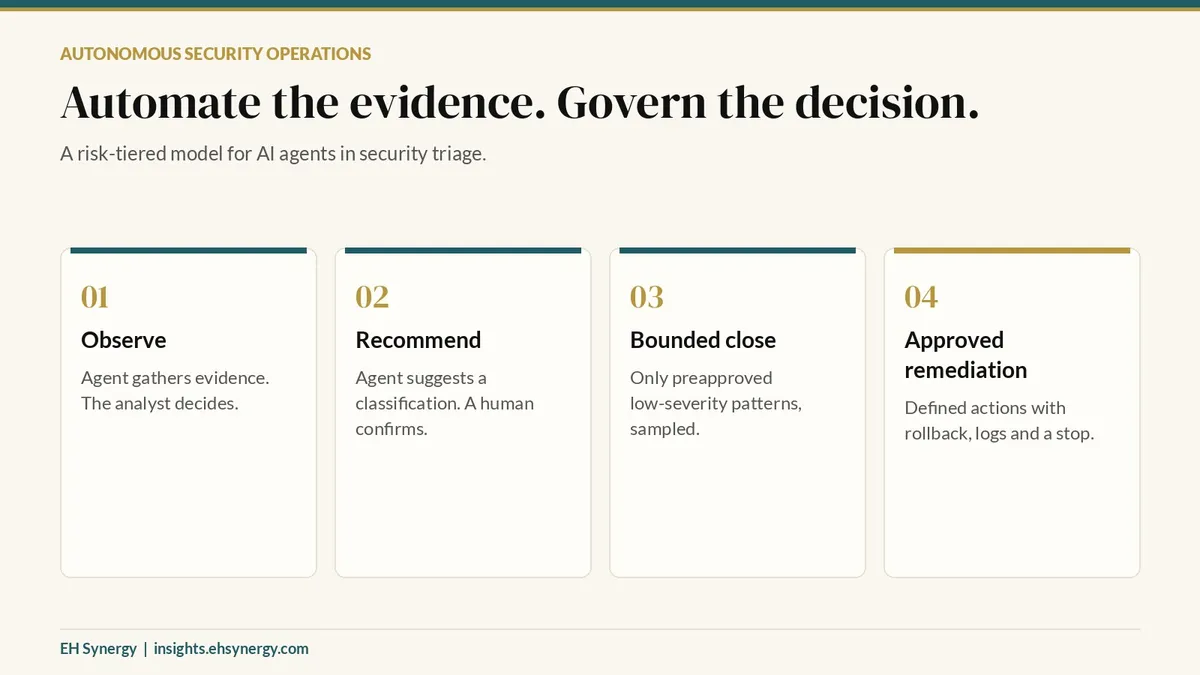
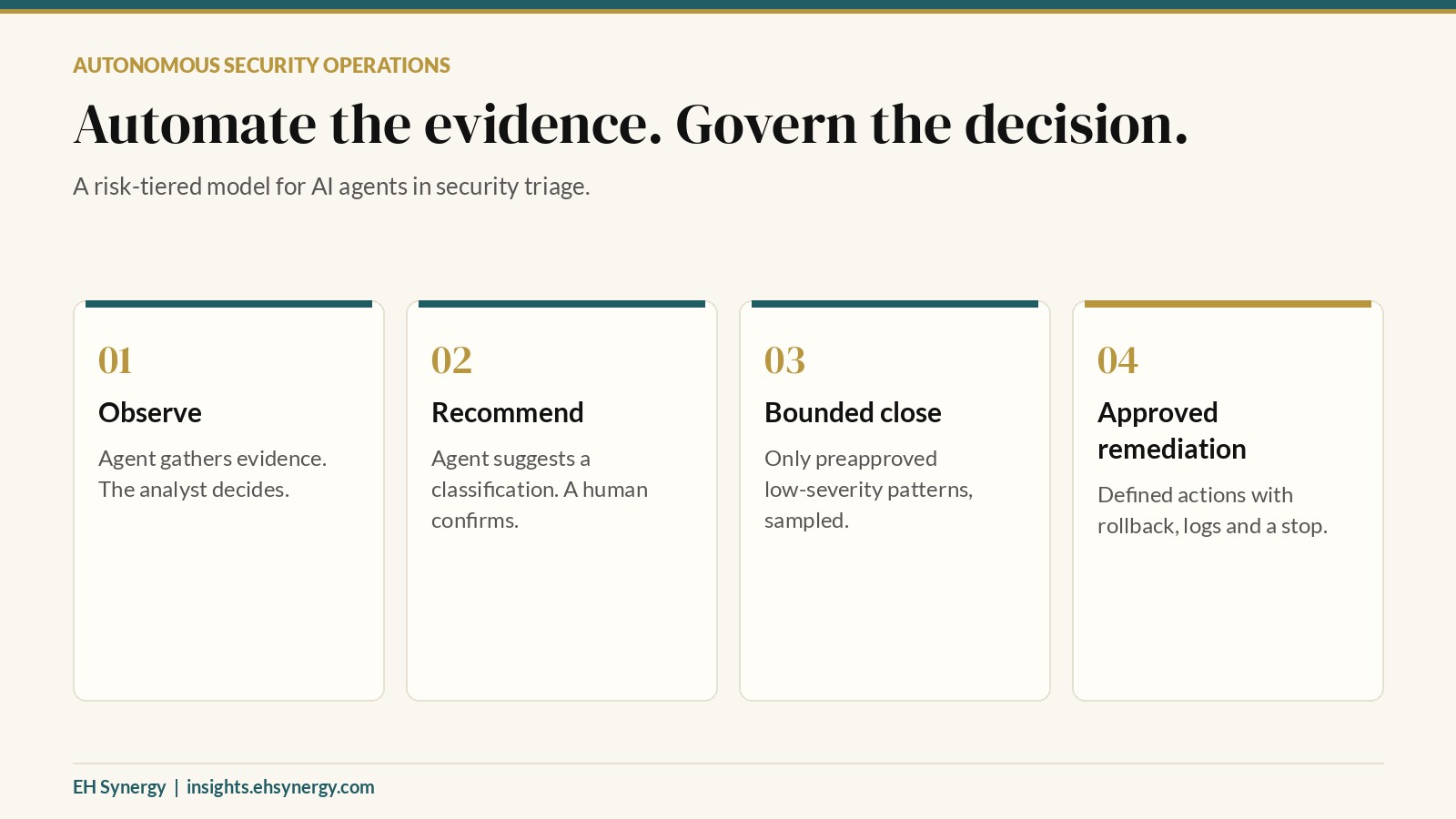
A Practical Four-Tier Autonomy Model
- Tier 0, observe: an agent retrieves evidence and drafts a case summary. The analyst makes every decision.
- Tier 1, recommend: an agent assigns a suggested classification and confidence, with documented reasons. A human confirms closure.
- Tier 2, bounded close: the agent closes only preapproved low-severity patterns after all required checks pass. A sampling program reviews outcomes.
- Tier 3, approved remediation: tightly defined actions may execute automatically with rollback, logging, and an emergency stop. High-impact actions still require explicit authorization.
The right tier depends on the potential harm of a wrong decision, the availability of reliable data, and how quickly the action can be reversed. A false positive wastes time. A false negative can leave a real incident unresolved. Treat those outcomes differently in evaluation.
Implementation Checklist
- Inventory alert types, monthly volumes, severity and evidence sources.
- Identify which cases are repetitive and low impact; exclude uncertain or irreversible actions from the first pilot.
- Define required evidence for each decision. A missing source must trigger escalation, not silent completion.
- Separate tool permissions for reading data, closing tickets and changing production systems.
- Record model version, evidence, tool calls, decision, user or agent identity and timestamp.
- Establish a human sampling process for closed cases and a clear incident-reopen procedure.
- Measure false negatives, escalations, analyst time, rework, customer impact and cost alongside closure rate.
- Review learned exceptions and allowlists on a schedule, especially after environment changes.
Worked Hypothetical Example
A company receives 600 alerts a month. It pilots AI evidence gathering for 150 repetitive, low-severity cases. If analysts currently spend 12 minutes gathering context for each, the gross manual effort associated with those cases is 30 hours a month. That is not a savings forecast. The pilot must subtract review time, failed runs, integration costs and additional monitoring, and it must confirm that quality is maintained. Only then should leadership consider broader autonomy.
Tradeoffs and Governance
Tiered agents can reduce repeated investigation, but they can also propagate mistaken assumptions through shared memory. Restrict automatic closure to cases with verifiable predicates, avoid relying solely on model confidence, and test how the system behaves when tools fail. In regulated environments, involve security, compliance and legal owners before deploying remediation.
Key Takeaways
- Start by automating evidence gathering, not irreversible actions.
- Treat false negatives and auditability as first-class metrics.
- Keep low-risk playbooks distinct from exceptional investigations.
- Require expiry and review for learned patterns.
If your organization is deciding which AI workflows should be automated and which should remain human-led, inquire about an AI Opportunity & Transformation Assessment through EH Synergy's existing contact channel.
About the Author
Erin Harris is an educator, AI strategy consultant, and business owner with an MBA in Marketing and a Master of Education (M.Ed.) in Educational/Instructional Technology, Western Governors University.