
Enterprise MCP Data Access: A Practical Governance Architecture
By Erin Harris, AI Strategy & Business Transformation Consultant
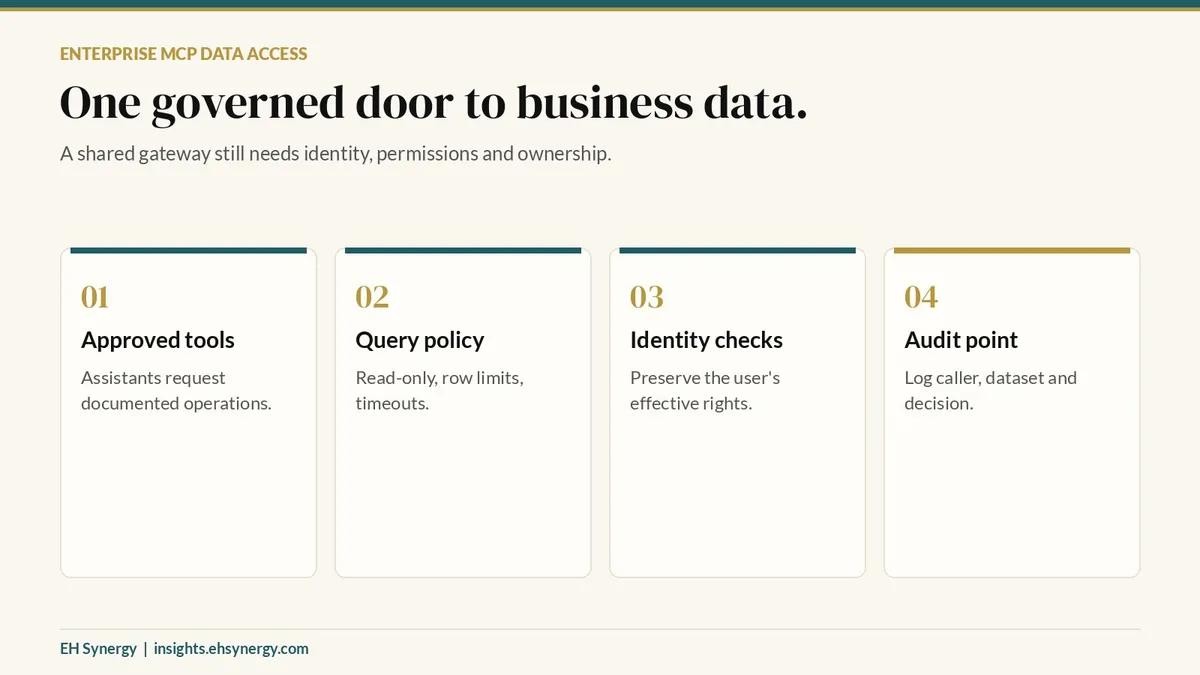
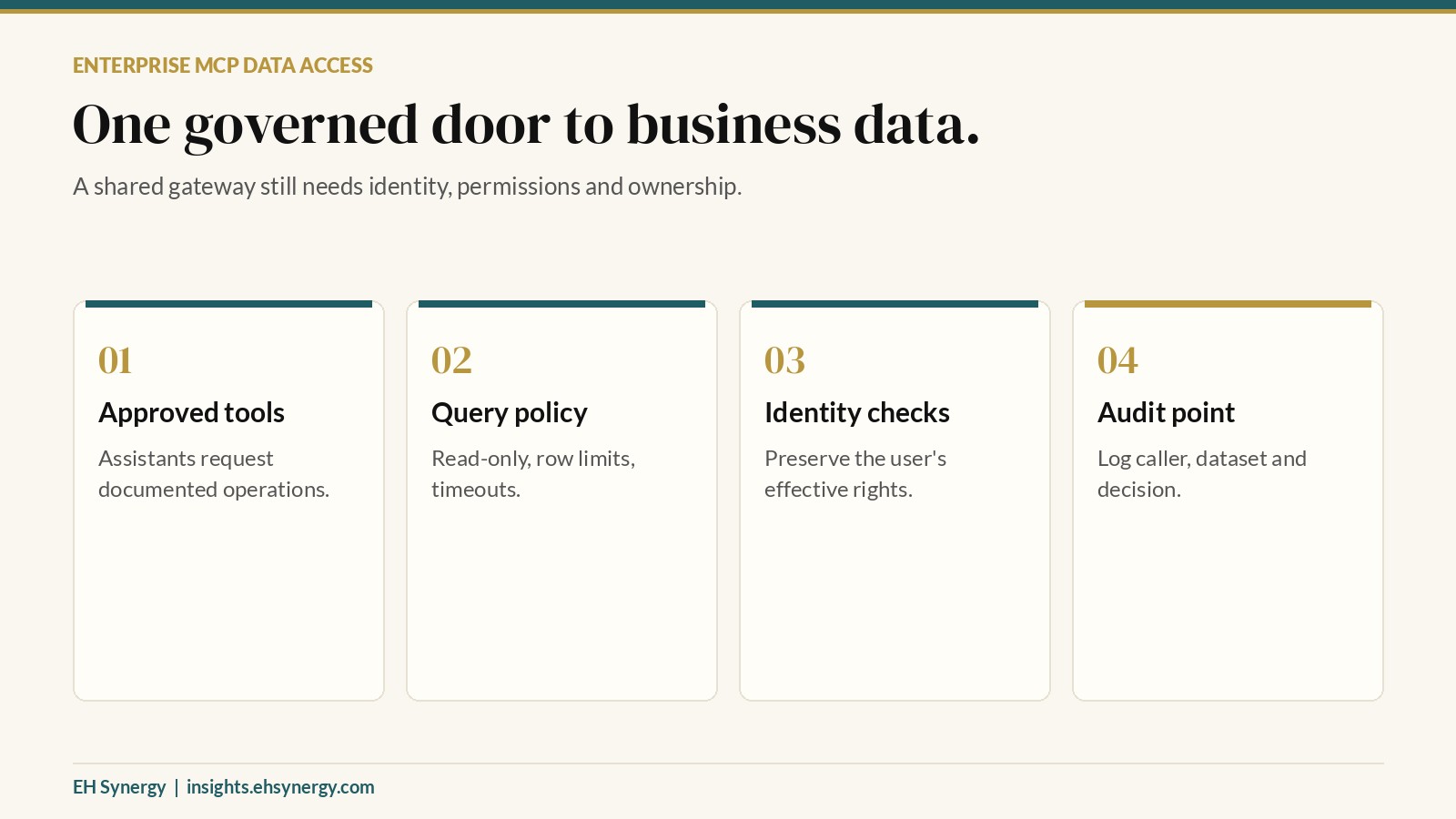
An enterprise MCP gateway gives multiple AI assistants a shared, governed way to request business data. Instead of allowing each assistant to maintain its own database integration, the gateway provides approved tools, common query restrictions, and a centralized audit point. This can reduce duplicated engineering effort. It does not eliminate the need for identity checks, row and column permissions, or data quality controls.
On November 6, AWS published an architecture case study about a metadata-driven Model Context Protocol server deployed on Amazon ECS Fargate for planning teams in Amazon's North America Sort Center network. The implementation uses JSON metadata to onboard datasets without writing separate integration code for each table. It also describes private networking, authenticated requests, SELECT-only Athena queries, and CloudWatch logging. This is a technical case study, not a new general-availability product launch or an independently validated cost-savings result. Source: https://aws.amazon.com/blogs/machine-learning/serverless-mcp-server-for-ai-agent-data-lake-access-on-amazon-ecs-fargate/
Why businesses need a shared data access layer
A company may start with one AI assistant connected to one database. The next assistant needs similar information, so another integration is created. Over time, different teams develop slightly different SQL logic, permission checks, logging, and schema assumptions. A change to one table can require updates in several applications. The problem is no longer the language model. It is the inconsistent access architecture surrounding it.
A shared gateway creates a stable contract between changing assistants and governed business data. Each assistant can request a documented tool operation without directly managing the underlying database connection. A single team can maintain tool definitions and observability. That makes access easier to inspect, although a centralized gateway also becomes a critical dependency that needs resilience planning.
A practical request flow
- An authenticated employee asks an approved AI assistant a business question.
- The assistant selects a registered MCP tool based on the request and documented tool descriptions.
- The gateway receives the request and identifies the effective user or workload.
- The tool layer checks dataset permissions, approved operations, and query constraints.
- A read-only query runs against the appropriate data source.
- The gateway returns bounded results and logs the tool call, policy decision, and error state.
- The assistant explains the result while retaining useful source and dataset context.
This is a reference workflow, not a claim that every MCP implementation automatically provides all seven controls. Each safeguard must be designed and tested.
An implementation checklist for leaders
- Data Inventory: Identify approved datasets, data owners, refresh schedules, sensitivity labels, and existing access rules. If a dataset has no owner, do not make it discoverable by default.
- Metadata Contract: Define schemas, column descriptions, allowed joins, business definitions, and change history. Metadata is a governed asset, not merely a convenient configuration file.
- Identity: Preserve the represented user's effective rights. Avoid a gateway that silently uses one highly privileged account for every request.
- Query Policy: Begin with read-only operations, enforce row limits and timeouts, validate generated SQL, and reject unapproved writes. AWS describes SELECT-only controls in its case study, but organizations must still test query cost and sensitive-data exposure.
- Sensitive Fields: Enforce row and column permissions in the execution layer. AWS explicitly describes finer-grained sensitive-column restrictions as future work in its published architecture, so readers should not assume the case study already implements a complete column-security system.
- Observability: Record tool identity, caller identity, dataset, access decision, duration, failures, and relevant version information. Avoid logging unnecessary personal data in clear text.
- Change Management: Test schema changes before metadata is published. Version tool definitions so older assistants fail safely when a dataset changes.
- Resilience: Define what happens when the gateway is unavailable. A shared access point can simplify governance while concentrating operational risk.
- Evaluation: Include correct answers, denied access, stale metadata, unexpected joins, incomplete data, and hallucinated interpretations in testing.
A worked hypothetical comparison
Imagine four business units, each with three separately maintained data connectors. That is twelve integration surfaces that may require updates whenever shared data definitions change. A central MCP layer could consolidate reusable query logic and permission enforcement. But it would also require infrastructure ownership, uptime monitoring, and policy administration. The financial decision should compare actual maintenance time, failure costs, cloud charges, and governance risk. Twelve integrations do not automatically become one permission rule, and a gateway is not free.
When this architecture makes sense
A shared gateway is particularly relevant when many agents need overlapping datasets, several teams maintain duplicated connectors, or compliance leaders cannot reconstruct which assistant accessed which information. For a single small assistant with a tightly bounded static dataset, the added complexity may not be justified. Start with the business bottleneck, not the architectural fashion.
What to measure in a pilot
Measure the time required to onboard an approved dataset, the number of duplicated integrations eliminated, denied unauthorized queries, query errors, schema-change recovery time, gateway availability, and total operating cost. Track whether business users receive correct, appropriately scoped answers. Faster onboarding without permission accuracy is not success.
Key Takeaways
- A shared MCP gateway can reduce repeated integration work across assistants.
- Metadata-driven onboarding requires data ownership and change controls.
- Read-only queries do not replace user-level and sensitive-column authorization.
- Centralized logging helps audits but centralization creates a shared failure point.
- Evaluate governance and operational cost alongside implementation speed.
If your organization is connecting multiple AI assistants to business systems, inquire about an AI Opportunity & Transformation Assessment through EH Synergy's existing contact channel. The assessment can help prioritize high-value workflows, reusable integration patterns, and the controls needed before production.
About the Author
Erin Harris is an educator, AI strategy consultant, and business owner with an MBA in Marketing and a Master of Education (M.Ed.) in Educational/Instructional Technology, Western Governors University.