
Gemini Decisions API: How to Build a Safer AI Routing Gate
By Erin Harris, AI Strategy & Business Transformation Consultant
The Gemini Decisions API is best evaluated as a bounded decision layer, not a replacement for a full business process. It can score predefined choices on shared inputs, but your organization still needs explicit rules for authorization, escalation and audit.
What Google Announced
On November 11, 2026, Google launched Gemini Decision 1 through its Gemini API in AI Studio. It supports yes/no, multiple-choice and rubric questions across text, images, audio, video and PDFs. Google advertises up to 1,000 questions per request, up to 256K input tokens, and $0.10 per million input tokens without billed output tokens. Reported latency and calibration are vendor benchmarks, not a service-level commitment for your workflow. Source: https://blog.google/innovation-and-ai/technology/developers-tools/gemini-decisions-api/
When a Decision Gate Fits
A decision gate is useful when a team already knows the legitimate categories. Examples include routing a general inquiry to sales or support, flagging an incomplete intake form, or checking whether an invoice contains required fields. It is a poor first choice when the task is open-ended strategy, novel dispute resolution or a safety-critical decision without an accountable reviewer.
A Worked Hypothetical
Imagine a 15-person property maintenance company. Its inbox receives invoices, appointment changes and urgent repair requests. Today a staff member opens each attachment and manually chooses a queue. A proposed pilot asks three bounded questions: Is this an invoice? Does the message include a property identifier? Does it allege an immediate safety issue? The system may propose a queue, but it never approves payment or dispatches emergency work by itself.
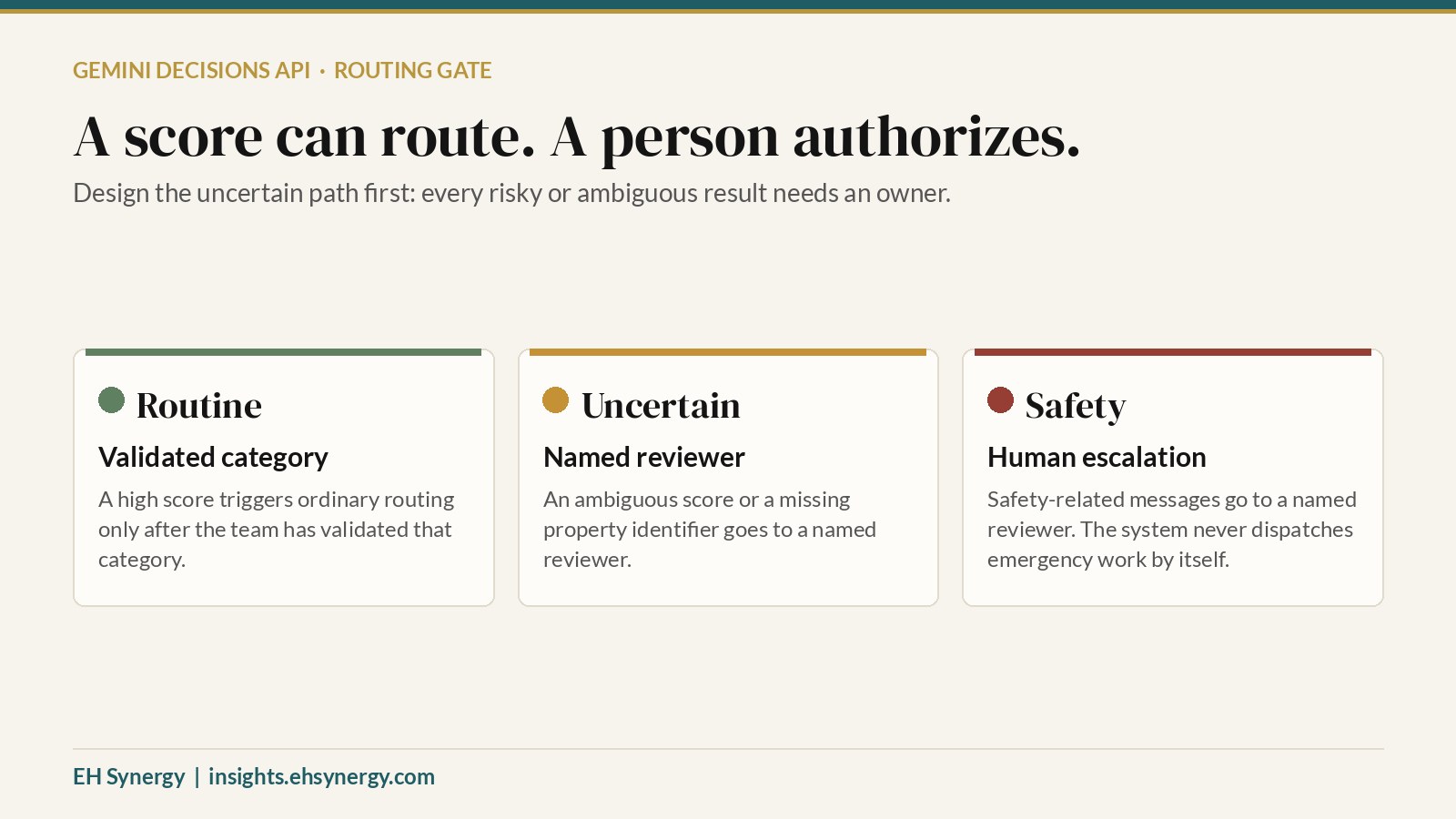
The distinction between a proposed queue and an authorized action must be enforced in software. A high score can trigger ordinary routing only after the team has validated that category. An ambiguous score, missing property identifier or safety-related message goes to a named reviewer.
The Six-Check Pilot
- Define a single measurable routing problem. Count current misroutes, handling time and correction burden before introducing AI.
- Create a label dictionary. Document examples and counterexamples for every yes/no, choice and rubric criterion.
- Build a representative test set. Include scanned documents, poor photographs, contradictory messages, non-English inputs if relevant, and cases that belong to no category.
- Set thresholds based on the cost of errors. The threshold for sending a newsletter question to a general inbox should differ from a threshold for classifying a potential safety emergency.
- Separate model output from action permissions. Log the result, model version, question version and human override. Do not give a classification endpoint unrestricted ability to change records or move money.
- Review weekly. Track false positives, false negatives, escalations, staff corrections and total cost, including human review.
Cost Is More Than Token Price
Google's announced token price is a useful input, not a total-cost estimate. The organization also pays for data preparation, application integration, monitoring, human review and remediation. Benchmark comparisons in the announcement do not replace a test using your actual case mix. Source: https://blog.google/innovation-and-ai/technology/developers-tools/gemini-decisions-api/
Decision Rule
Proceed to a narrow pilot when labels are stable, representative cases are available, and every risky or ambiguous result has an owner. Delay deployment when the business cannot explain what happens after a wrong answer.
Key Takeaways
- Use bounded scoring for repeatable choices, not undefined judgment.
- Test the exceptions before automating routine cases.
- Make escalation and audit logging part of the initial design.
- Evaluate total workflow cost and error impact, not only API price.
For organizations evaluating where AI belongs in their operations, EH Synergy's AI Opportunity & Transformation Assessment can help identify the right workflows, decision boundaries and implementation priorities. Inquire through EH Synergy's existing verified contact channels.
Source: https://blog.google/innovation-and-ai/technology/developers-tools/gemini-decisions-api/