
Google Cloud Spend Caps for AI Projects
What the October 2026 general availability release means for business cost controls
By Erin Harris, AI Strategy & Business Transformation Consultant
Google Cloud spend caps are now generally available for eligible services through Google Cloud Budgets. They can programmatically enforce project and service spending boundaries, use faster estimated cost signals for certain AI services, and automatically reset eligible blocked services at the beginning of a new month.
They are not a universal guarantee that every cloud charge will stop. Google says Provisioned Throughput is not halted, and eligibility matters. Businesses should begin with non-production projects, document what will be interrupted and confirm the relevant billing permissions before relying on the control. Official Google Cloud announcement, October 30, 2026
That is the short answer. The more important business question is how spend caps fit into a complete AI governance process.
Key Takeaways
- Spend caps can enforce limits for eligible Google Cloud project and service usage.
- API management, live estimated costs and monthly reset behavior are part of the GA update.
- Alerts are informational; enforcement can pause eligible usage.
- Provisioned Throughput and reserved capacity are not halted by these caps.
- Test caps in a sandbox and assign a clear owner before using them near production workflows.
What changed on October 30?
Google announced three improvements alongside general availability.
First, the spend caps API can be accessed through the Cloud Billing Budgets API. This makes it possible to apply or update eligible caps programmatically instead of configuring each one manually.
Second, live estimated costs for AI services can trigger enforcement within minutes and appear in Cost Reports, giving teams a more immediate view of why a cap was triggered. Those estimates should not be confused with finalized net billing.
Third, enforced caps now reset automatically at the beginning of the month, allowing blocked eligible services to resume. Organizations that require manual review can retain a manual override approach. Google Cloud announcement
The release is a financial-control feature, not an AI model capability. Its significance is operational.
Three controls that should not be confused
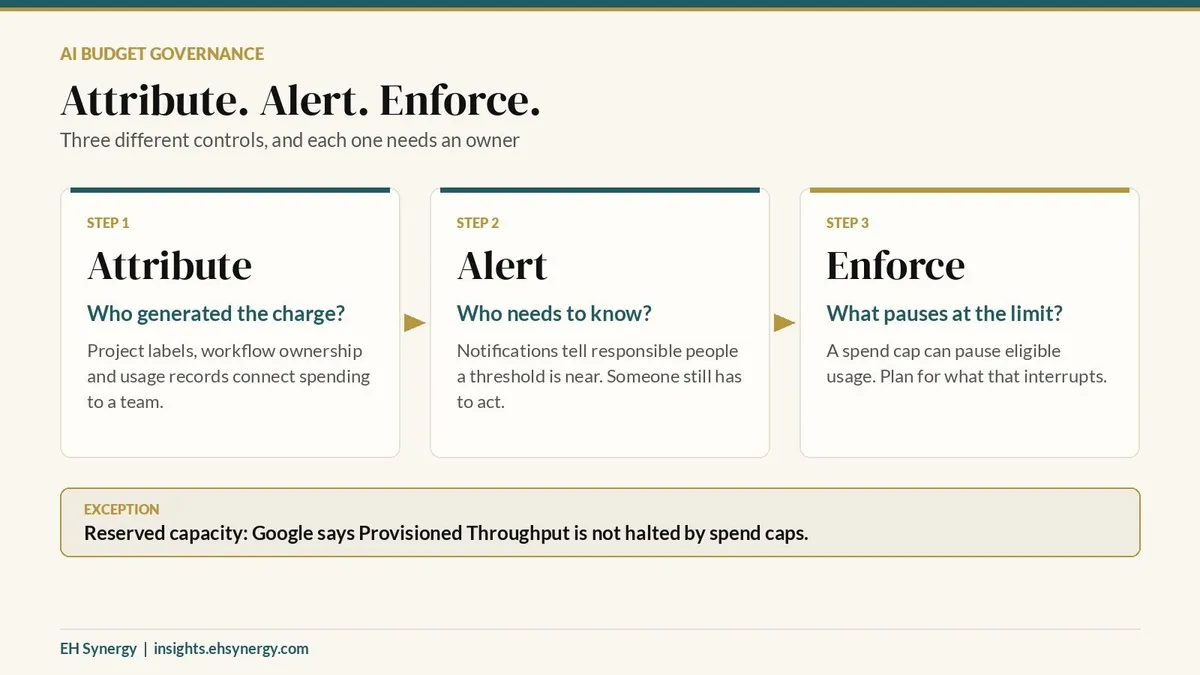
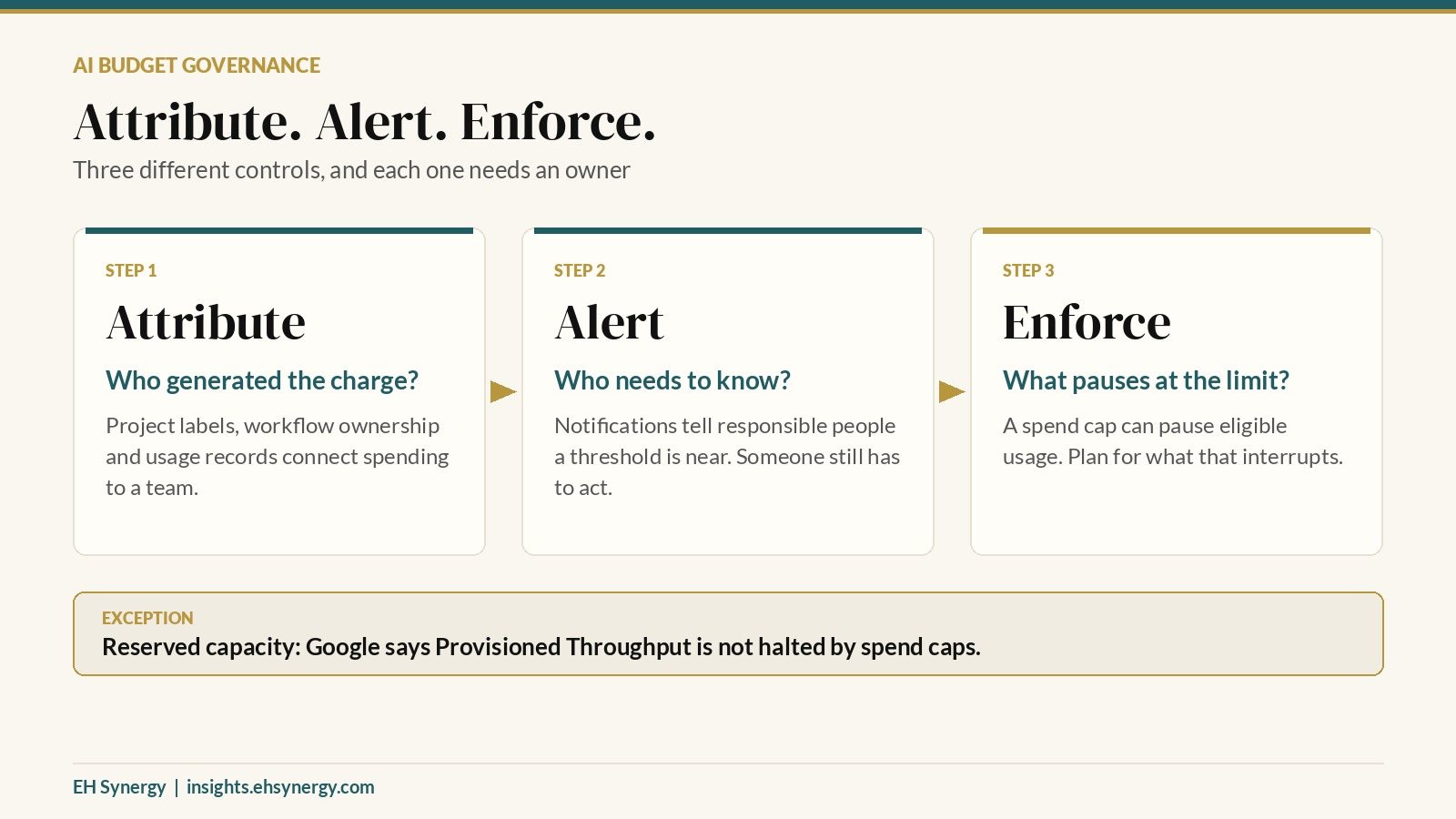
Cost attribution answers who generated a charge. An organization may need project labels, workflow ownership and usage records to understand whether a marketing assistant, support bot or developer test produced the bill.
Budget alerts tell responsible people that spending has reached a threshold. Google describes default notifications to billing administrators and project owners at 50, 80 and 100 percent of a cap.
Spend caps add an enforcement mechanism for eligible services. Once triggered, affected usage can be paused. That can limit experimental exposure, but it can also interrupt a process.
These controls work together. A business that knows the total bill but cannot assign it to an owner has an attribution problem. A business that sends alerts without someone acting on them has a response problem. A business that blocks a production service without a fallback has a continuity problem.
A five-step deployment checklist
1. Inventory the workloads
List each project, service, owner, environment and billing model. Identify usage-based workloads and any reserved or committed capacity.
Google notes that Provisioned Throughput continues even when a spend cap triggers. Do not promise complete financial containment without checking those exceptions. Google Cloud announcement
2. Separate experiments from production
Create distinct non-production environments where feasible. A sandbox can tolerate interruptions that would be unacceptable in a customer-facing service.
Google explicitly recommends beginning with strict, low-dollar caps on development sandboxes, testing clusters and AI agent playgrounds.
3. Assign a human decision owner
The billing administrator and the technical owner may be different people. Decide who receives alerts, who can change a cap, who approves exceptions and who documents the outcome.
4. Test a safe threshold
In a controlled non-production setting, verify that notifications arrive and that eligible usage pauses as expected. Check which requests fail and how the application communicates that condition.
Do not perform an uncontrolled spending test to prove a limit works.
5. Choose the reset policy deliberately
An automatic monthly restart is useful for a recurring development allowance. A manual approval may be safer for sensitive or unusual workloads.
Write down the decision and review it when the workload changes.
Worked hypothetical: a customer-service AI pilot
Consider a hypothetical company piloting an AI assistant that summarizes support tickets. The team gives the experiment its own project and a modest monthly budget. The billing owner receives threshold notifications, while the technical owner monitors service errors.
If the cap is reached, the test can stop while the team examines why usage increased. That is acceptable for a pilot with no customer dependency.
Now suppose the assistant is used in a live support workflow. A sudden pause might delay agents or customers. The business may need a different design: alerts, a fallback manual process, careful capacity planning and a documented incident response.
The same control can be appropriate in one environment and harmful in another. That is why governance begins with the workflow, not the setting.
Questions to ask before calling a budget protected
Which services are eligible? Are any charges tied to reserved capacity? Are cost estimates current enough for the intended control? Who receives notifications? What is the behavior when a cap triggers? What happens on the first day of the next month?
Google's announcement establishes the broad capability. Exact account access, SKU coverage and production suitability must be verified in current Google Cloud documentation and the organization's own billing configuration.
Where an AI assessment adds value
EH Synergy's AI Opportunity & Transformation Assessment examines operational workflows, existing tools, ownership and the financial and implementation decisions behind an AI project. For an organization adopting usage-based AI services, cost governance belongs in that assessment alongside expected value and failure handling.
The goal is not to impose the lowest possible spending limit. It is to choose a level of experimentation and service continuity the organization can explain and support.
Learn more about EH Synergy at https://ehsynergy.com.
Official source: Google Cloud, October 30, 2026: https://cloud.google.com/blog/topics/cost-management/google-cloud-spend-caps-now-generally-available/