
How to Evaluate an Agentic AI Architect Beyond Certification
By Erin Harris, AI Strategy & Business Transformation Consultant
A certification can be a useful hiring signal for an agentic AI architect, but it should not replace an evidence-based technical assessment. Employers need to know whether a candidate can design agents that operate across applications while protecting data, respecting permissions and recovering from failure.
Google Cloud announced its Professional Agentic Architect certification on November 11, 2026. Google describes a two-part assessment: a proctored multiple-choice exam and practical Google Skills labs. The credential targets developers, cloud architects and engineers building multi-step, multi-app agents on Google Cloud. This is a vendor-specific qualification; its announcement does not independently validate a candidate's ability in every enterprise environment. Source: https://blog.google/innovation-and-ai/infrastructure-and-cloud/google-cloud/professional-agentic-architect/
What the Role Actually Requires
An agentic architect connects business objectives to technical boundaries. That includes choosing which actions can be automated, defining identity and permissions, handling sensitive data, setting approval gates, tracing execution and planning recovery when an external tool fails. These are operational responsibilities, not merely prompt-writing skills.
The Hiring Scorecard
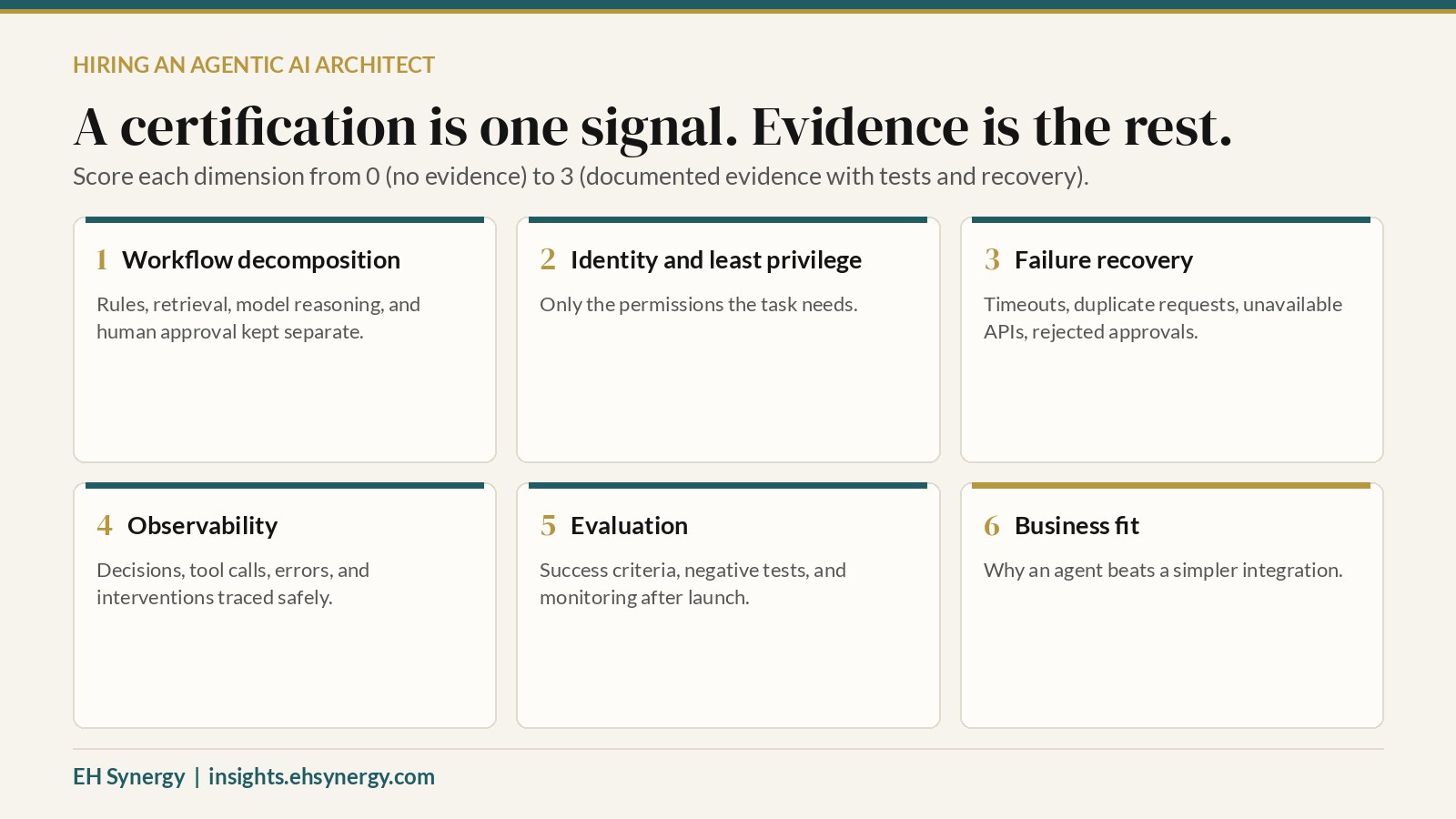
Score each dimension from 0 to 3: 0 means no evidence, 1 means conceptual explanation only, 2 means working demonstration with limitations, and 3 means documented evidence with tests and recovery.
- Workflow decomposition: Can the candidate separate deterministic rules, retrieval, model reasoning and human approval?
- Identity and least privilege: Can they explain how the agent receives only the permissions needed for the task?
- Failure recovery: Can they demonstrate what happens after a timeout, duplicate request, unavailable API or rejected approval?
- Observability: Can they trace decisions, tool calls, errors and human interventions without exposing sensitive content?
- Evaluation: Can they define success criteria, negative tests and monitoring after launch?
- Business fit: Can they justify why an agent is preferable to a simpler integration or standard automation?
Maximum score: 18. The numerical score is a proposed internal rubric, not a validated industry standard. Require evidence on identity and failure recovery regardless of the total score.
A Practical Interview Exercise
Give candidates a fictional service business scenario: a customer submits a change request, the agent checks an internal record, proposes an update and asks a supervisor for approval. Midway through, the customer record API returns an error. Ask the candidate to diagram the system, show what should be logged, explain whether the agent retries and identify how to avoid duplicate updates. This scenario tests architecture thinking without requiring access to confidential production systems.
A candidate who can build a polished happy-path demo but cannot explain duplicate writes or access boundaries needs more evaluation. A candidate who openly limits the agent's permissions and proposes a reversible pilot may demonstrate stronger operational judgment.
How to Use the New Credential
The Google Cloud certification may help screen candidates for Google-centered environments and provide a structured learning path. Google says its preparation program includes 35 free monthly learning credits. Confirm current exam cost, eligibility, renewal terms and exact assessment format through the official program before adding it to a job requirement. Source: https://blog.google/innovation-and-ai/infrastructure-and-cloud/google-cloud/professional-agentic-architect/
Do not require a single vendor badge for a role that primarily uses another cloud or a mixed stack unless the credential genuinely matches the work. Experience with governance and architecture principles can transfer, even when the product names differ.
Key Takeaways
- Treat certification as one signal, not a substitute for technical evidence.
- Assess least privilege, recovery and auditability explicitly.
- Use a scenario that includes a failure, not only a successful demo.
- Match credential requirements to the organization's actual technology stack.
EH Synergy's AI Opportunity & Transformation Assessment can help leadership teams define which workflows require agent architecture, what safeguards matter, and what implementation capabilities to seek before hiring or contracting. Inquire through EH Synergy's established business contact channels.