
How to Measure AI Coding Agent Cost Per Completed Task
A practical benchmark for model routing decisions
By Erin Harris, AI Strategy & Business Transformation Consultant
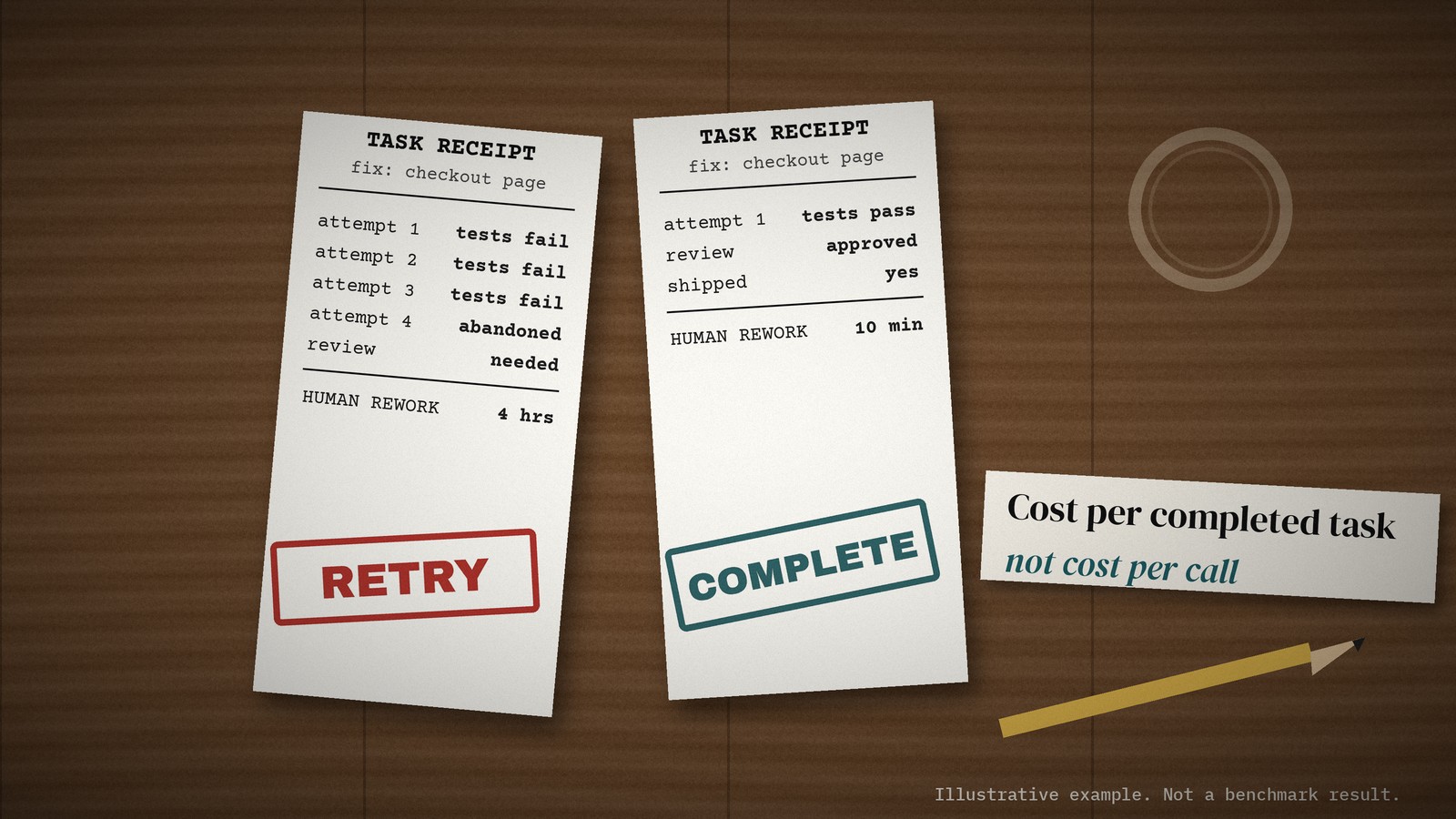
The most useful cost metric for an AI coding agent is total spending divided by successfully completed, independently tested tasks. A low token rate does not establish a low cost of useful work.
AWS published a November 13, 2026 walkthrough for routing coding-agent requests through LiteLLM and NVIDIA NeMo Switchyard on Amazon Bedrock. It describes Stage routing based on tool history and Random routing for controlled comparisons. AWS explicitly identifies the sample as experimental and non-production. Source: https://aws.amazon.com/blogs/machine-learning/route-coding-agent-requests-to-the-right-model-on-amazon-bedrock-with-nvidia-nemo-switchyard/
Why this matters
A coding agent can make dozens of calls while reading files, editing code and running tests. Each call consumes resources, including calls that lead nowhere. A team that compares only input and output token prices can reward the wrong configuration.
Define the unit of value
Start with an actual business outcome. For a software team, that might mean a bug fix that passes automated tests and a code review. For a website agency, it might mean a page update that passes accessibility, mobile layout and link checks. A generated code file is not the same as an accepted deliverable.
Create a task register with task ID, complexity, expected result, pass/fail criteria, agent configuration, number of turns, model cost estimate, elapsed time and human correction minutes. Keep failures in the register. Excluding them inflates apparent performance.
A worked hypothetical example
Configuration A runs ten comparable tasks and spends $12 on inference. Six pass. Its estimated inference cost per solved task is $2. Configuration B spends $18 and completes nine. Its cost per solved task is also $2. If A requires 90 minutes of developer repair while B requires 20, B may deliver better economics even though its total inference bill is higher. These numbers are illustrative, not AWS benchmark results.
Test routing against a baseline
First, run the same representative task set with a single model. Next, test a routed configuration with identical success criteria, turn limits and review rules. Repeat enough times to understand variability. Separate simple edits from complex debugging, because averages can conceal task-specific failures.
Record three metrics together: completion rate, cost per completed task and human rework. Add elapsed time where speed matters. A router that saves tokens but reduces pass rates or adds operational fragility is not automatically an improvement.
Control the experiment
Use a non-production account and sanitized repositories. AWS warns that its sample's benchmark runner executes model-generated Python and is not an operating-system sandbox. It also warns that costs are estimates based on usage and price tables rather than final invoices. Validate permissions, network exposure, credentials, model region support and actual billing before expanding a pilot.
Decision framework
Choose a single model when it reliably handles the task mix with acceptable cost and review burden. Consider routing when workload complexity varies substantially and measurements show a durable advantage. Stop or redesign automation when failure recovery costs more than the work saved.
The objective is not the most elaborate architecture. It is an accountable system that produces accepted work at a defensible total cost.
Key Takeaways
- Define an independently testable finished task before measuring cost.
- Include failed attempts and human rework.
- Compare routing with single-model baselines on the same task set.
- Keep experimental routing samples outside production until security and reliability are validated.
- Use actual billing and repeated tests before claiming savings.
EH Synergy LLC offers an AI Opportunity & Transformation Assessment to evaluate workflow dependencies, implementation readiness, and measurable business value. Inquire through EH Synergy's established contact channels.