
Before You Automate HR, Redesign the Employee Journey
Read Between the Roles | By Erin Harris
A company can automate a form, route an email in seconds, and deploy an AI assistant without making the employee experience meaningfully better. The underlying process may still require six approvals, three system changes, and repeated requests for the same information. Faster fragments do not necessarily produce a better whole.
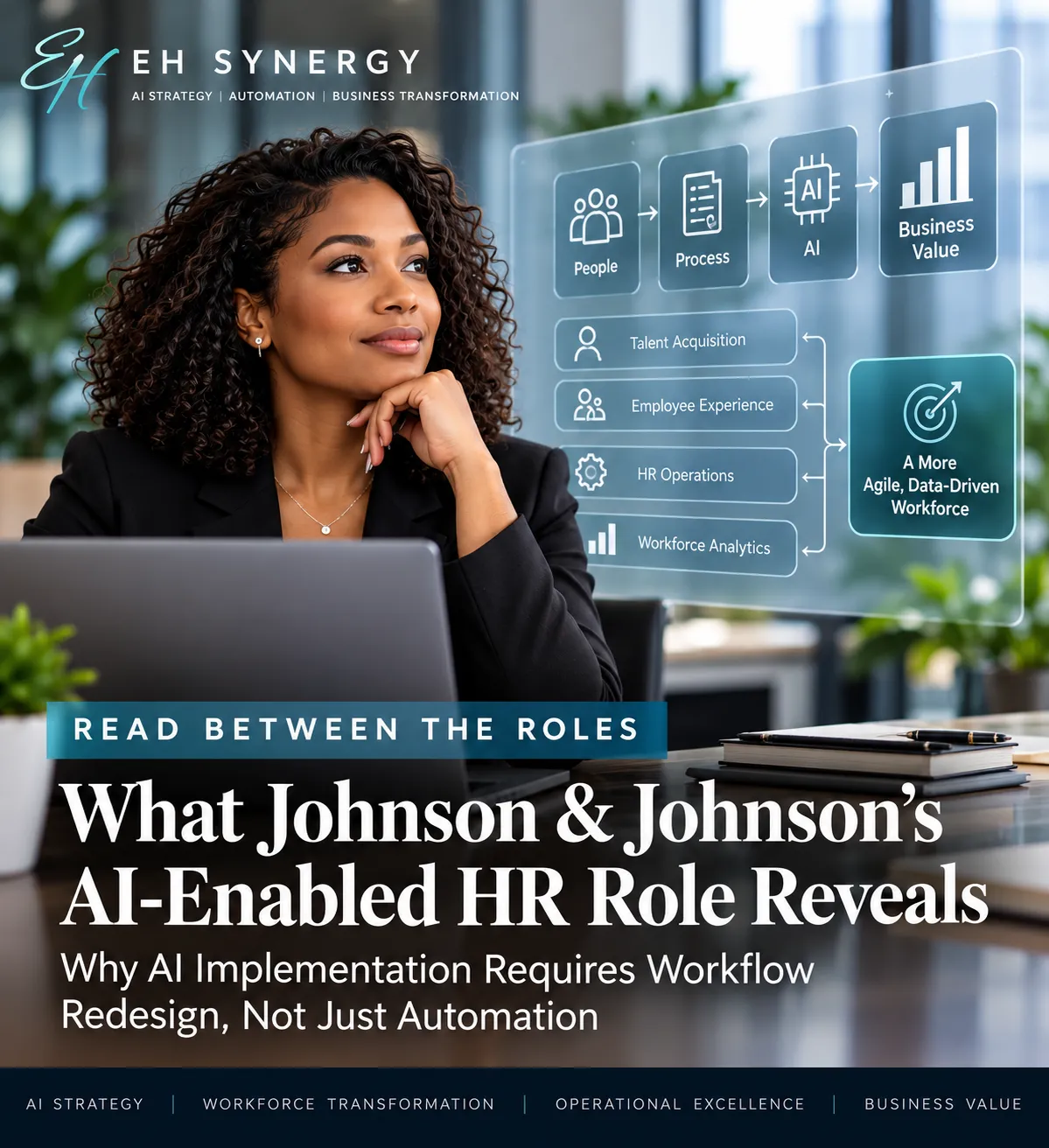
That is why a Johnson & Johnson leadership posting caught my attention. Its Director of AI Enablement and Business Process Architecture role is not simply tasked with finding AI use cases. The published description places future-state workflow design, employee experience, governance, and measurable outcomes at the center of the work. That distinction is relevant far beyond a global healthcare organization.
What the job posting actually says
The October 16, 2026 posting, requisition R-105589, describes responsibility for AI enablement and business process architecture across the Hire-to-Retire employee lifecycle. It calls for end-to-end blueprints covering decisions, roles, controls, data, and handoffs, and specifically emphasizes designing workflows before digitizing or automating them. It also calls for prioritizing opportunities according to value, employee impact, readiness, risk, and capacity.
Those are published responsibilities, not evidence that Johnson & Johnson has a particular operational failure. A job description tells us what capabilities the company seeks to build or strengthen. It does not reveal the company’s internal performance or prove why the role was created.
What they may really be hiring for
My interpretation: the strategic need is someone who can connect the employee journey to process ownership, technology decisions, and operational accountability. AI specialists can build a useful assistant; process architects must decide whether the assistant is solving the right problem in the right sequence.
This is a leadership and operating-model challenge. Who has authority to remove a redundant approval? Who owns the accuracy of employee information across systems? Who decides when an AI-enabled decision requires human review? Those questions determine whether an automation scales or merely accelerates confusion.
A concrete example: onboarding
Imagine a growing professional-services company onboarding ten employees per month. HR collects identity details, IT requests the same details for account creation, payroll asks for another form, and a manager follows up on equipment. An AI chatbot might answer onboarding questions, but it will not by itself eliminate duplicate data entry or clarify which team owns each handoff. This is a hypothetical example, not a description of Johnson & Johnson’s operations.
A better sequence starts with mapping the employee’s journey from accepted offer to productive first day. Identify every input, owner, wait state, approval, exception, and system of record. Then eliminate unnecessary steps, standardize the remaining process, and decide where automation belongs.
For example, a single approved onboarding trigger might initiate equipment provisioning and orientation tasks while keeping payroll changes and sensitive exceptions behind appropriate controls. The point is not to promise full autonomy. It is to make the process understandable, accountable, and easier to complete.
A practical workflow audit a smaller business can run
First, select one recurring process with a measurable cost: onboarding, lead intake, client handoff, or invoice approval. Second, observe actual work rather than relying on the documented ideal. Third, mark repeated data entry, waiting time, exception paths, and unclear decisions. Fourth, agree on a future-state owner and control points. Fifth, pilot one change before expanding automation.
Measure elapsed cycle time, number of handoffs, rework, employee or customer effort, error rates, and time to resolve exceptions. Do not treat the number of AI tools installed as proof of value. A process that becomes more reliable with fewer steps may justify the investment even if AI plays only a modest role.
The market signal and the consulting lesson
The posting illustrates a broader leadership question: who designs the business process that AI is expected to improve? It is tempting to start with software selection because demos are visible and exciting. But an organization gets lasting value when the workflow, decision rights, data, controls, and adoption plan fit together. One posting is an example of this approach, not proof of a market-wide trend.
For founder-led businesses, the lesson is practical: you do not need an enterprise AI department to adopt enterprise-quality thinking. You need to understand the work before paying to automate it.
Bring the question into your business
At EH Synergy, I help businesses identify where work gets stuck, clarify workflow ownership, and prioritize practical AI and automation opportunities around measurable business outcomes. If you are considering AI but are not sure which processes are ready, start with the process rather than the product.
Book a free strategy call with EH Synergy. Bring one recurring workflow, the tools your team uses, and the bottleneck you want to resolve.
Source and disclosure
Johnson & Johnson Careers: Director, AI enablement and Business process architecture. Posted October 16, 2026; requisition R-105589. Source checked October 18, 2026. This article analyzes the dated posting and does not guarantee that applications remain open.
Independent EH Synergy commentary. No affiliation with Johnson & Johnson or access to its internal operations is implied.