
Reliable AI Transcription Workflows: Queues, Retries and Cost Controls
A practical resilience blueprint for audio-processing and other asynchronous AI tasks
By Erin Harris, AI Strategy & Business Transformation Consultant
Reliable AI transcription requires more than an accurate model. It requires a job architecture that preserves requests, recovers interrupted work, avoids duplicate outcomes and respects delivery and data residency requirements.
AWS's November 13, 2026 AssemblyAI case describes GPU inference on mixed EC2 Spot and On-Demand capacity, diversified instance families, Amazon SQS queues and independent regional deployments. AWS reports 70% savings on inference compute versus On-Demand pricing for this deployment. Spot instances can be reclaimed with a two-minute warning. These results are specific to the reported architecture. Source: https://aws.amazon.com/blogs/machine-learning/cost-optimizing-assemblyai-speech-to-text-inference-on-aws-with-amazon-ec2-spot/
Why interruptions change the design
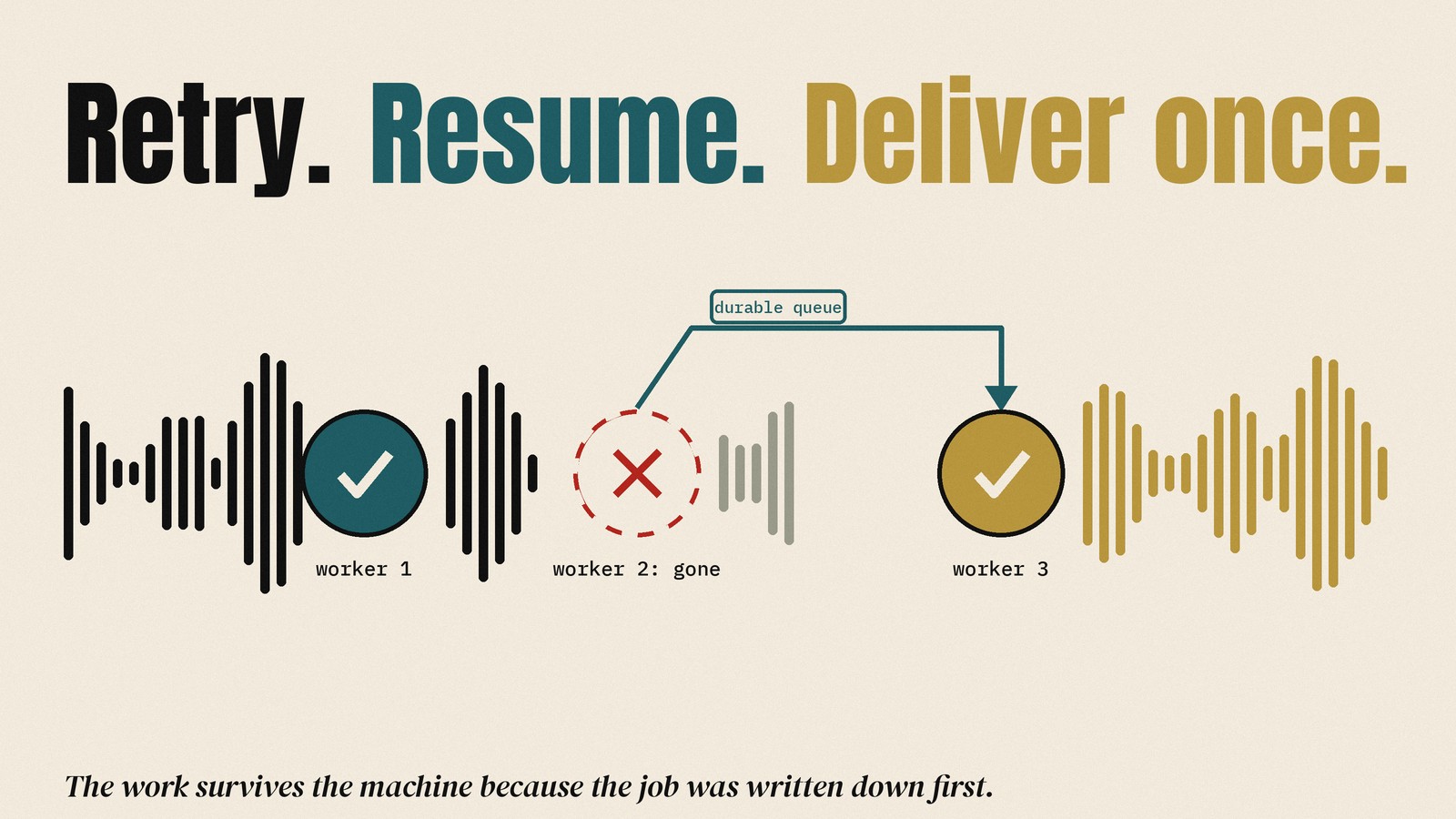
An audio-processing request may take seconds or minutes. If a worker disappears midway, the system must decide whether to retry, resume or fail visibly. Without durable state, the customer may need to resubmit the file. Without duplicate safeguards, the same job may run twice and produce conflicting records.
The resilient job blueprint
- Accept the request and assign a stable job ID. Store authorized metadata and the input location in a durable system. Acknowledge receipt separately from completion.
- Place the job on a durable queue. Workers should pull tasks only when capacity is available. Set sensible visibility timeouts and dead-letter handling.
- Make processing idempotent. A retry should not create duplicate customer charges, duplicate final files or repeated downstream notifications. Use job-state checks and safe writes.
- Detect interruptions and retry safely. When a worker is reclaimed or times out, return unfinished work to the queue after appropriate checks. Use bounded retries and escalation for repeatedly failing jobs.
- Maintain fallback capacity. Evaluate the tradeoff between lower-cost interruptible compute and On-Demand capacity for time-sensitive requests. Define the maximum acceptable queue delay.
- Monitor the customer outcome. Track accepted jobs, completed jobs, end-to-end latency, retry rate, failure rate and cost per delivered transcript. Infrastructure utilization alone does not show whether the service works.
- Apply residency and privacy requirements. Decide where recordings and derived transcripts may be stored or processed. The AssemblyAI case describes separate regional infrastructure for residency needs, but a different business must validate its own obligations.
A worked hypothetical example
A research agency uploads 100 interview recordings. Each receives a job ID. A worker starts recording 27, then loses capacity. The queue returns that job for another worker, which produces the final transcript once. The client dashboard reports the job as completed only after the final artifact is validated. If the second attempt also fails, the system marks the job for review rather than claiming success. This example illustrates a design pattern, not AssemblyAI's actual customer workflow.
How to evaluate cost
Separate compute expense from total service expense. Add storage, queue operations, monitoring, retry compute, engineering support, compliance controls and the cost of missed deadlines. The AWS case's 70% figure applies to inference compute compared with On-Demand pricing. It does not establish the same percentage for total operating costs.
Before adopting interruptible capacity, run a pilot across normal and peak demand. Inject simulated worker failures. Confirm that jobs complete once, deadlines are met and customers receive accurate status information. Compare total cost per successful delivery against a simpler baseline.
When not to use this pattern
A small operation with low volume may find the added engineering overhead greater than the infrastructure savings. Highly time-sensitive jobs may require a larger non-interruptible capacity reserve. Some workloads may not be safe to retry without special controls. The right architecture depends on workload characteristics and service commitments.
The strategic lesson is that cost optimization and reliability need not be opposites. But the savings are only useful when recovery is designed, tested and measured as part of the service.
Key Takeaways
- Preserve each request with a durable job ID and queue.
- Use idempotent writes and bounded retries to prevent duplicate outcomes.
- Measure cost per delivered transcript, not only GPU rates.
- Test worker interruption and recovery before production.
- Validate privacy, residency and latency commitments for each workload.
EH Synergy LLC offers an AI Opportunity & Transformation Assessment to evaluate workflow dependencies, implementation readiness, and measurable business value. Inquire through EH Synergy's established contact channels.