
Safe AI Workflow Design for Caregiver and Community Support Organizations
By Erin Harris, AI Strategy & Business Transformation Consultant
A privacy-first operating model for nonclinical administrative assistance.
Community organizations can use AI to reduce routine coordination work, but only when they draw a firm line between administrative support and professional advice. A responsible pilot should start with low-risk, source-grounded tasks and explicit human review.
OpenAI Academy's November 10, 2026 caregiver workshops, organized with three health and caregiver organizations in five U.S. cities, focus on schedules, checklists, resource navigation, and plain-language educational materials. They also teach privacy and the limits of AI. This is a training initiative, not a validated clinical system. Source: https://openai.com/index/helping-caregivers-use-ai-in-everyday-life/
Start With a Task-Risk Matrix
Low-risk candidate: create a generic appointment preparation checklist without names or diagnoses. Moderate-risk candidate: summarize a publicly available educational handout while linking to the original and requiring staff review. High-risk or unsuitable autonomous task: interpret a patient's symptoms, recommend treatment, or send sensitive information to an unapproved service. The boundary is defined by consequences and data exposure, not by how easy a prompt is to write.
A Four-Stage Pilot
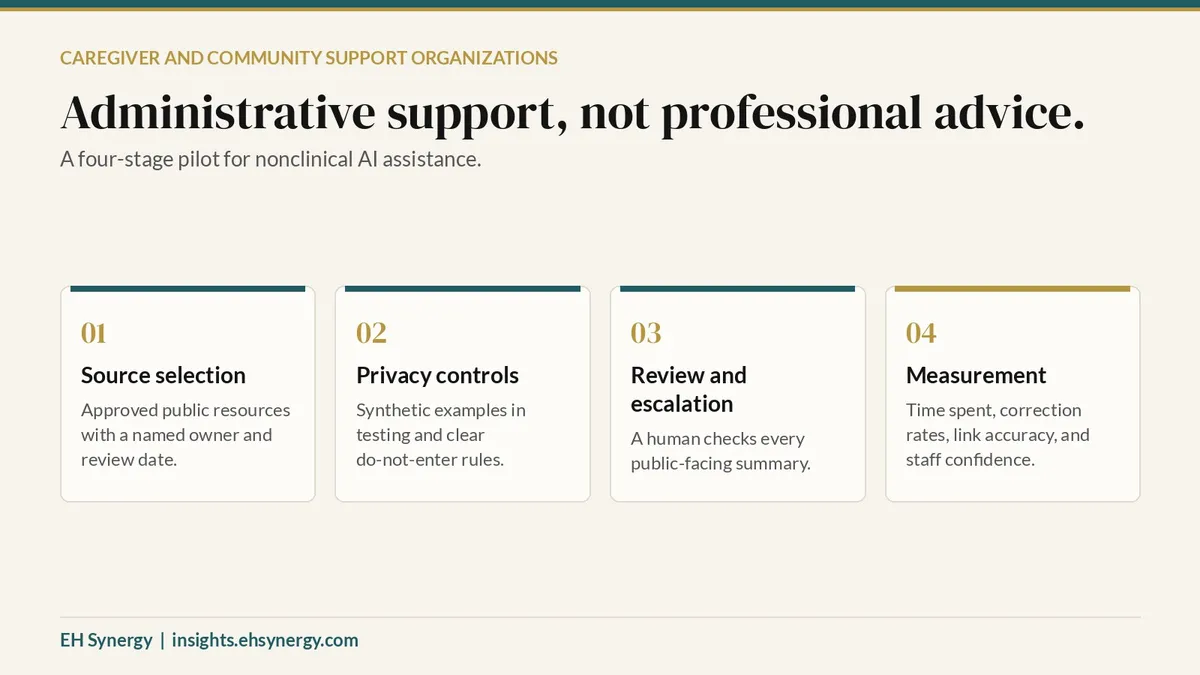
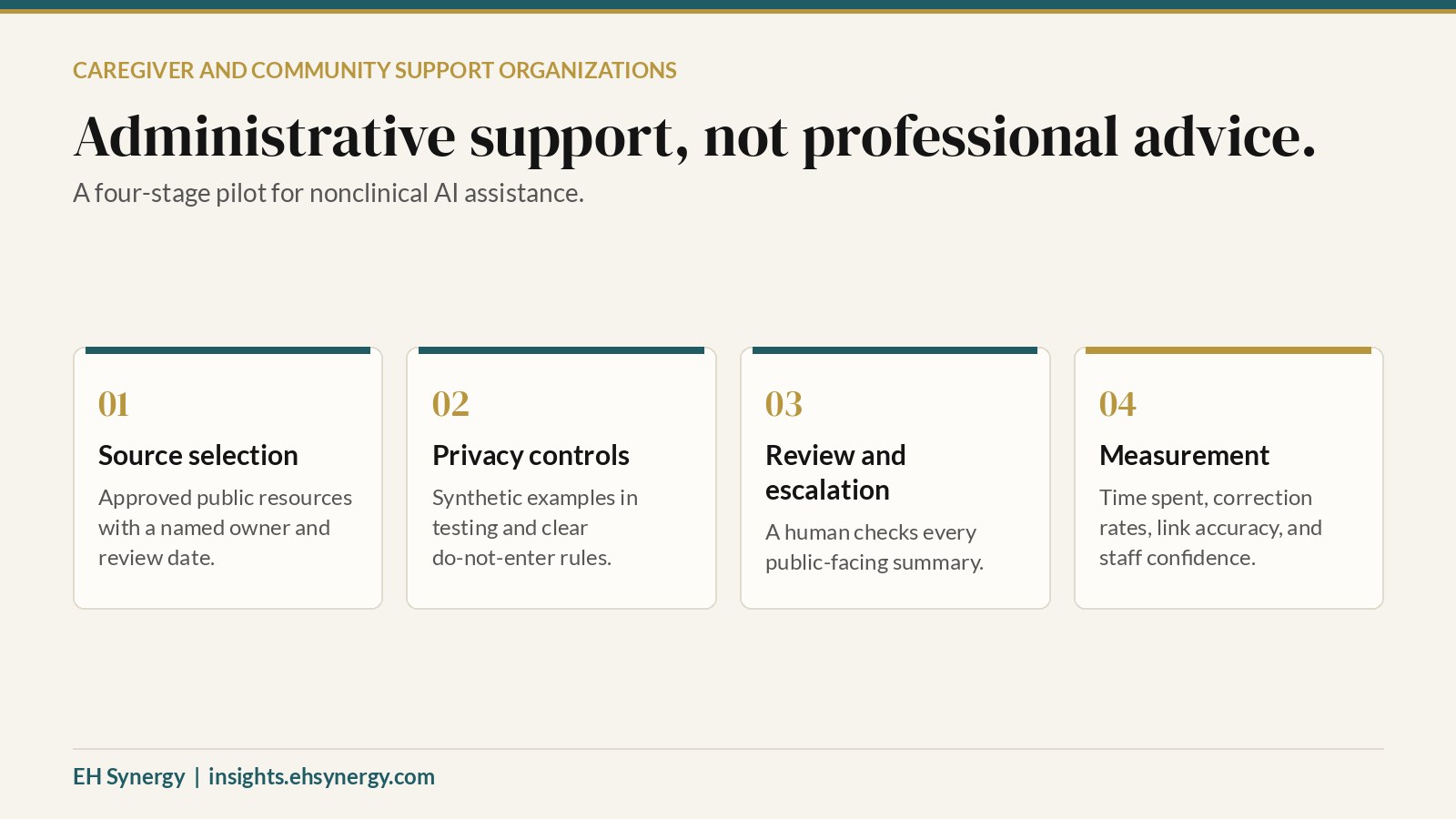
Stage 1, source selection: choose a short library of current, approved public resources. Record who owns updates and when each document was last reviewed.
Stage 2, prompt and privacy controls: use synthetic examples during testing. Prohibit identifiable client information unless the organization has completed its own legal, security, and vendor review. Provide staff with clear do-not-enter examples.
Stage 3, review and escalation: require a human to check every public-facing summary for accuracy, links, accessibility, and unsupported advice. Route medical, legal, benefits, and crisis questions to appropriate qualified services.
Stage 4, measurement: track time spent preparing routine materials, correction rates, source-link accuracy, and staff confidence. Collect feedback without turning sensitive caregiver experiences into an unapproved dataset.
Worked Hypothetical Example
A nonprofit receives repeated questions about how to prepare for a caregiver support meeting. Staff supply an approved public flyer. AI drafts a plain-language checklist from that flyer, citing the original. A coordinator checks dates, contact details, reading level, and accessibility before sharing it. The AI does not invent eligibility criteria, store participant health histories, or answer clinical questions. The result is a controlled publishing workflow, not an automated care advisor.
What Not to Claim
OpenAI estimates more than 40 million weekly U.S. healthcare-related ChatGPT messages ask about someone else, based on a limited October 2026 usage window. That estimate cannot be converted into demand for a particular product, evidence of patient benefit, or a privacy guarantee. The workshop announcement does not report independent outcome evaluation. Source: https://openai.com/index/helping-caregivers-use-ai-in-everyday-life/
Key Takeaways
- Begin with administrative tasks and approved public sources.
- Separate content assistance from diagnosis and professional judgment.
- Test with synthetic data before handling sensitive information.
- Measure correction rates and usefulness, not just output volume.
EH Synergy's AI Opportunity & Transformation Assessment can help organizations identify suitable use cases, decision rights, and implementation safeguards. Inquire through the established EH Synergy contact channel to discuss a scoped assessment.
Source: https://openai.com/index/helping-caregivers-use-ai-in-everyday-life/