
Silent Data Corruption in AI Training: A Model Integrity Response Plan
By Erin Harris, AI Strategy & Business Transformation Consultant
An AI training job can finish without obvious infrastructure errors and still produce compromised model weights. Silent data corruption occurs when hardware returns a plausible but incorrect calculation without a conventional fault signal. For teams operating distributed training, the operational answer is to combine integrity checks, independent verification and a tested recovery path rather than relying solely on node health.
AWS published a technical approach for Amazon SageMaker HyperPod on November 11, 2026. The post describes three types of checks, localization of suspect nodes and rollback from a clean checkpoint. Its demonstration uses injected faults under specified conditions, so it should not be treated as universal detection. Source: https://aws.amazon.com/blogs/machine-learning/detecting-and-recovering-from-silent-data-corruption-on-amazon-sagemaker-hyperpod/
The failure mode
In distributed data-parallel training, many workers compute gradients and synchronize updates. A wrong finite number may pass a basic NaN or infinity check. Once incorporated into a shared update, it can affect other replicas. Conventional health checks are valuable for reported hardware faults but may not detect a computation that looks numerically ordinary.
Three complementary integrity controls
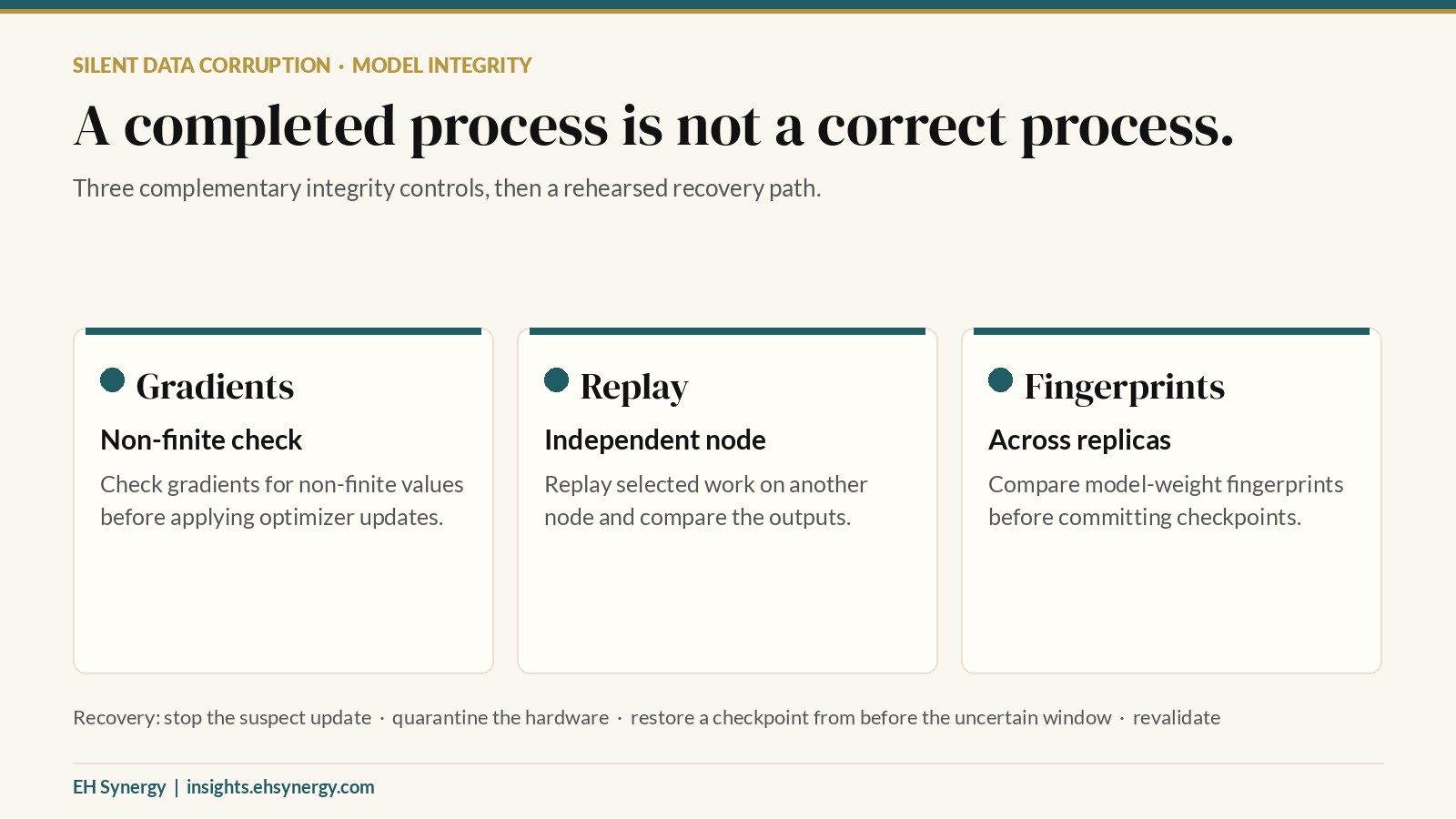
First, check gradients for non-finite values before applying optimizer updates. This catches obvious invalid arithmetic but not every plausible wrong value.
Second, replay selected work on another node and compare the outputs. Independent computation helps expose discrepancies that the original worker does not report. The schedule, deterministic assumptions and node topology matter.
Third, compare model-weight fingerprints across replicas before committing checkpoints. Divergent weights can indicate that the replicas have not remained synchronized. Fingerprinting is not a replacement for computation-level audits.
A response plan that operators can actually use
Define an alert threshold before the training run begins. When a check fails, stop the suspect update rather than allowing the questionable result to propagate. Record the affected step, worker, node and last verified checkpoint. Quarantine the suspect hardware and use the cluster's supported replacement mechanism. Restore a checkpoint from before the uncertain window, then revalidate before resuming.
This sequence must be rehearsed. A backup that exists but cannot be restored is not a recovery strategy. A checkpoint that was created after the fault may be a faithful copy of compromised state.
Worked hypothetical incident
Suppose a ring replay audit finds disagreement between one worker and its independent counterpart at step 450. The team knows the last clean checkpoint was step 420. It pauses training, preserves logs and fingerprints, investigates the suspect worker, and rolls back to step 420 if the integrity investigation supports that choice. The team does not claim step 440 is safe merely because it saved successfully. This is a hypothetical teaching scenario, not a reported AWS customer incident.
A decision framework for audit frequency
Consider the cost of a missed error, the duration of a training run, the cost of repeating compute, and the overhead of replay. A high-stakes training program may justify more frequent audits than a disposable experiment. But frequent checks can materially slow training. The AWS publication discusses overhead and specific test conditions. Teams should benchmark their own configuration rather than importing a vendor example as a service-level guarantee.
Questions before adoption
Can the training job reconstruct micro-batches for independent replay? Does the cluster have enough independent nodes? Which kernels are deterministic? How are faults isolated? What is the clean-checkpoint criterion? Who can authorize a rollback? What failures remain undetectable? The answers determine whether this approach fits the actual environment.
The broader business lesson
Organizations buying AI services should ask vendors about integrity evidence and recovery practice, not simply uptime. A completed process is not necessarily a correct process. The verification method must fit the failure mode and consequence.
Key Takeaways
- Silent corruption may pass ordinary hardware and numerical health checks.
- Gradient checks, independent replay and weight fingerprints cover different risks.
- Checkpoint validity must be demonstrated before recovery.
- Detection costs compute and must be risk-calibrated.
- Vendor demonstrations are not universal production guarantees.
AI Opportunity & Transformation Assessment
For teams evaluating AI infrastructure or high-consequence automation, EH Synergy's AI Opportunity & Transformation Assessment can help identify the business workflow, control requirements and evidence needed before implementation. Inquire to discuss scope and suitability.