
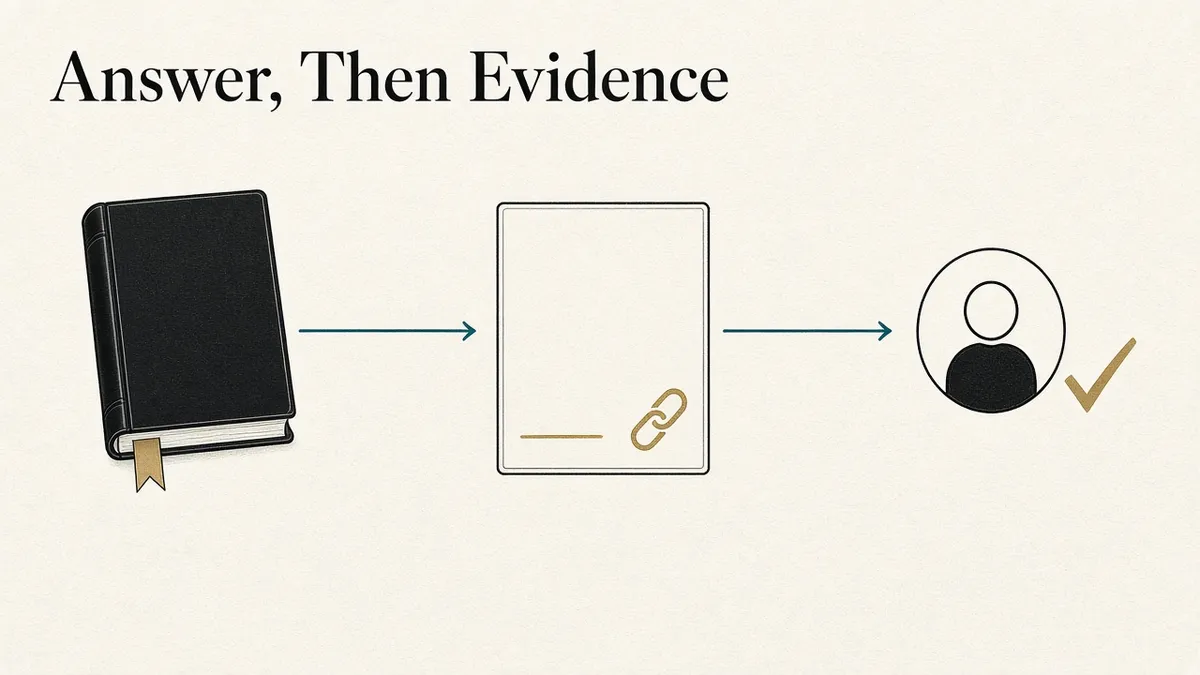
Source-Grounded AI for Employee Knowledge Bases: What Businesses Can Learn from Google's Textbook Update
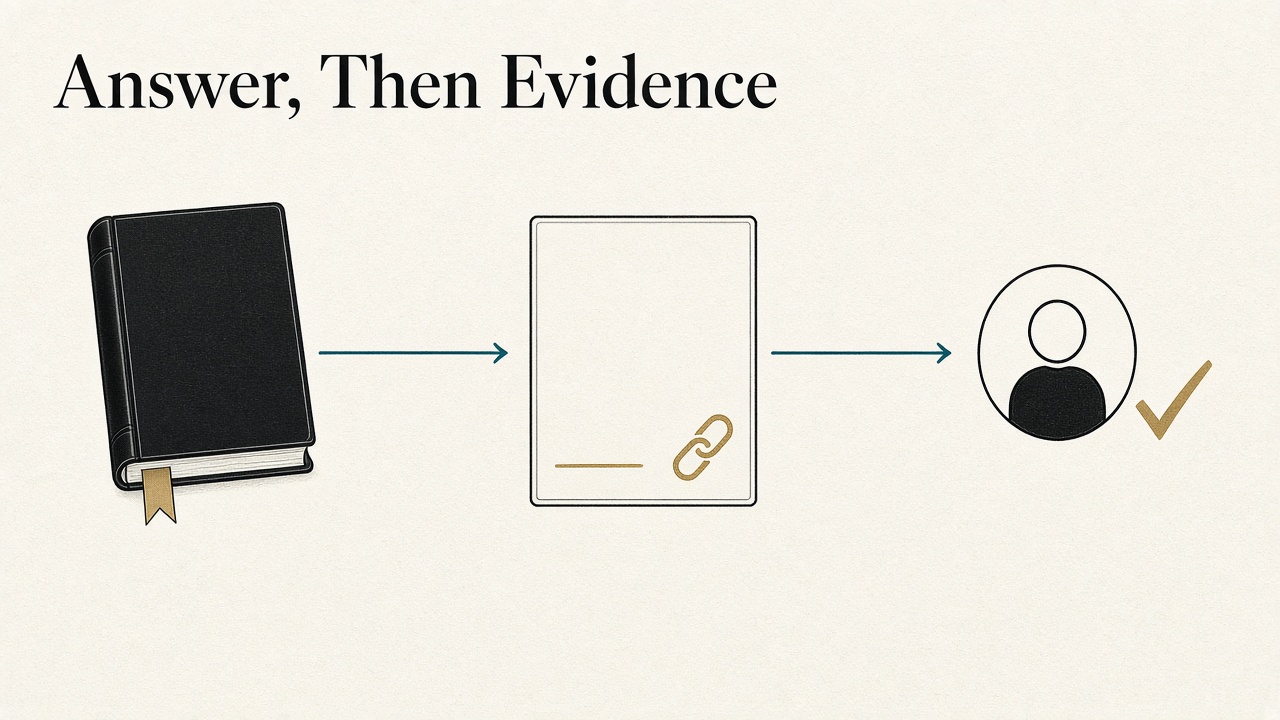
A new student feature illustrates a practical question for organizations: can employees trace an AI answer back to the approved document?
By Erin Harris, AI Strategy & Business Transformation Consultant
A business AI assistant should not merely answer questions about company procedures. It should make it possible to verify which approved procedure supports the answer, especially when the answer affects a customer, employee, or financial decision.
On October 29, 2026, Google announced that Gemini Notebook now provides access to hundreds of textbooks from providers in the United States and India, including OpenStax, Open Textbook Library, and S Chand Publishing. Google says the feature grounds answers in selected textbooks and displays inline citations and links to the source. Students can also generate study guides, quizzes, and flashcards from the material. Source: https://blog.google/innovation-and-ai/products/gemini-notebook/new-access-textbooks/
This is a student-facing announcement, not an enterprise knowledge-base launch. Its relevance to business is a design principle: the quality of an AI answer is easier to assess when the underlying source is visible.
Why an answer without a source creates operational friction
Imagine a service company whose employees frequently ask how to handle rescheduling, deposits, and cancellations. The rules may be spread across a website, internal handbook, CRM notes, and old email templates.
An AI assistant could produce a confident answer to a question about refunds. If it does not identify the governing policy, the employee has to search manually to determine whether the answer is current. If the assistant uses an outdated document, the company may communicate the wrong terms.
This is a hypothetical scenario, not a reported customer incident.
The problem is partly technological and partly organizational. Even a well-designed retrieval system cannot make conflicting or outdated policies authoritative. Someone must decide which source controls and who is responsible for maintaining it.
The four parts of a source-grounded knowledge workflow
A useful knowledge assistant needs more than a collection of uploaded files.
- Approved source. Identify the current policy, procedure, contract, or knowledge article that should govern the answer. Record its owner and revision date.
- Traceable response. Configure the system, where supported, to identify the document or passage used. If it cannot find an approved source, it should communicate uncertainty rather than invent a policy.
- Verification. Employees should be able to open the cited source and confirm the answer before making a consequential decision. High-impact actions may require a second approval.
- Feedback and maintenance. When an employee finds an outdated source or misleading answer, there should be a process to correct the source, test the assistant, and document the change.
These steps are an EH Synergy editorial framework. They are not claims about the technical capabilities of every AI platform.
A practical example: the rescheduling policy
Suppose a hypothetical business permits a free reschedule up to 24 hours before an appointment. A customer asks about moving a booking 12 hours before the scheduled time.
A weak assistant might respond based on a general customer-service pattern, such as promising flexibility. A source-grounded assistant should retrieve the actual policy and identify the relevant exception or escalation rule. If no exception is documented, it should not invent one.
The workflow can be tested with several cases: requests 48 hours ahead, requests 12 hours ahead, customers with special agreements, and situations where the policy document is missing.
The evaluation should ask whether the assistant selected the right source, stated the rule accurately, and escalated uncertain cases. A fluent answer is not the same as a compliant answer.
Key Takeaways
- Source-linked answers make verification possible, but do not guarantee accuracy.
- An AI knowledge base needs approved documents, named owners and revision controls.
- Employees should verify consequential answers before acting.
- Missing or conflicting sources should trigger clarification or escalation.
- Measure correct application of policy, not only response speed.
What Google's announcement does and does not establish
Google's new feature concerns textbooks in Gemini Notebook. Its announcement says students can browse an available catalog at no charge and receive source-linked answers. It does not establish that every textbook is included, that citations are error-free, or that students learn more because of the feature.
Nor does it mean that an organization can automatically reproduce the same workflow using any chatbot. Enterprise implementations may require different permissions, licensing, integrations, document processing, and security controls.
The transferable lesson is the importance of evidence visibility. The technical solution must still be evaluated for the organization's systems and risks.
Questions to ask before connecting AI to company knowledge
What is the authoritative source for each common question? Who can change it? Can the assistant cite the specific policy? What should happen when sources disagree? Can staff identify when a document was last updated? Which actions require human approval?
For organizations with CRM workflows, booking systems, or employee onboarding processes, these questions belong in the initial workflow assessment, not only in final testing.
From a helpful answer to a dependable process
A company knowledge assistant can reduce searching and help employees locate information. Its real value depends on whether people can trust the process behind the answer and recognize when the system should not decide alone.
An AI Opportunity & Transformation Assessment can help organizations map existing information sources, workflow decisions, and review responsibilities before investing in more automation. For information about EH Synergy's systems work, visit https://www.ehsynergy.com/.
Source and limitations: Google, "Gemini Notebook makes hundreds of textbooks available," October 29, 2026: https://blog.google/innovation-and-ai/products/gemini-notebook/new-access-textbooks/. The business examples and four-part framework are editorial applications, not reported Google product features or EH Synergy customer results.