

Voice AI Agent Readiness Checklist for Business

What to verify before turning your company knowledge into a conversational representative
By Erin Harris, AI Strategy & Business Transformation Consultant
A voice AI agent can help customers or employees ask questions aloud, receive answers grounded in approved documents, and continue a conversation without searching through multiple pages. But before a business chooses a voice or avatar, it needs to establish which information the agent can use, who owns that information, and what happens when an answer is missing.
Microsoft's October 30, 2026 walkthrough of Voice Agent in Foundry Agent Service provides a useful example. The product connects Foundry IQ knowledge with speech and an optional photo avatar. The demonstration uses a knowledge base and includes an out-of-scope question the agent cannot answer from that source. Microsoft's guidance also emphasizes consent for personalized voices and avatars, and notes that availability varies by model, region and feature. Primary source
The following checklist is a vendor-neutral operational framework inspired by those design decisions. It is not a claim that every vendor provides the same capabilities.
Key Takeaways
- Begin with an approved, owned knowledge collection, not the appearance of the agent.
- Test whether answers are grounded in current source documents.
- Require consent and appropriate disclosure for personalized synthetic identity.
- Define a human handoff for uncertain, sensitive or consequential questions.
- Pilot with measurable quality criteria before expanding the audience.
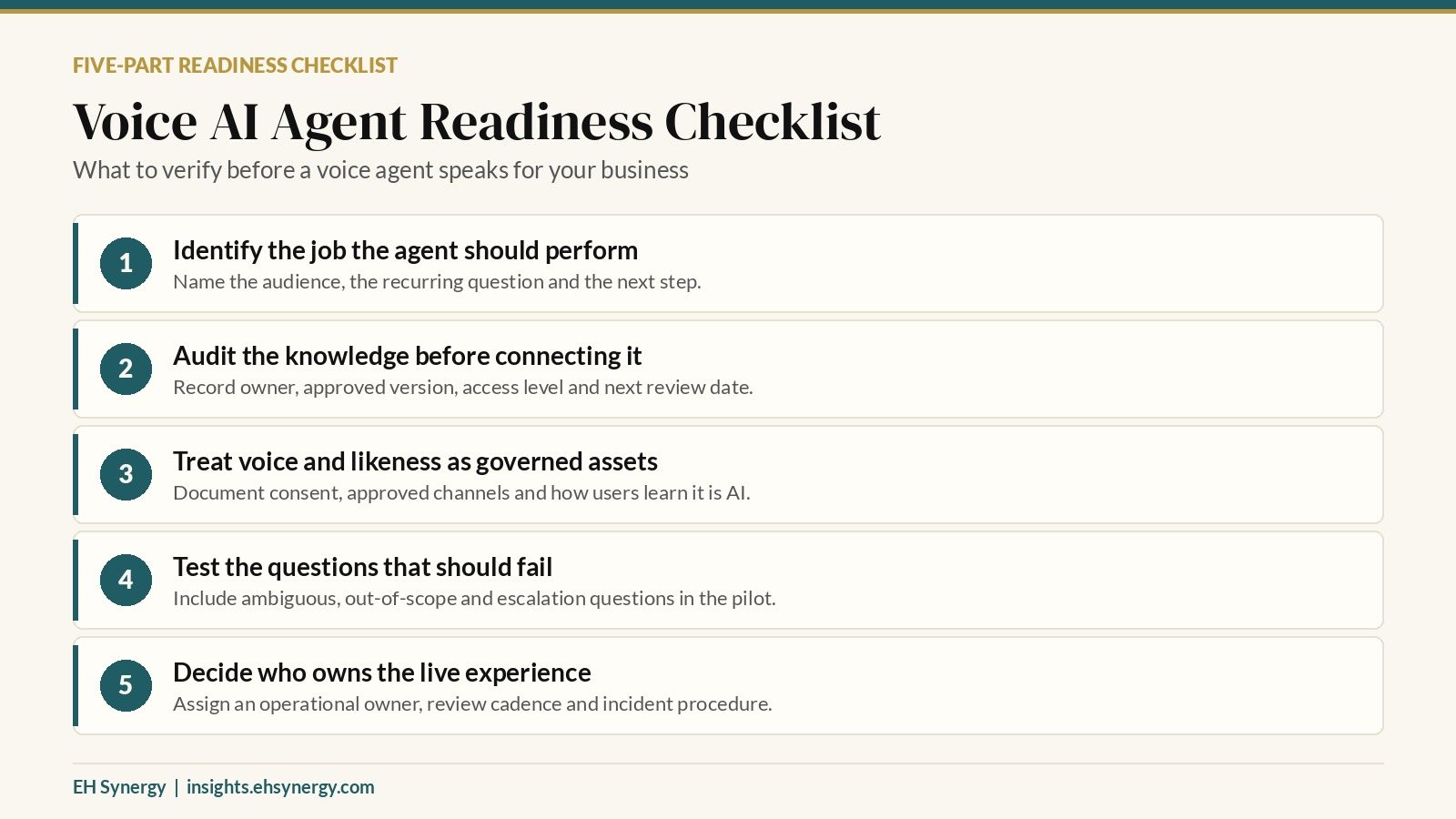
1. Identify the job the agent should perform
A voice interface is a delivery method, not a business objective. A useful objective names the audience, the recurring question and the desired next step.
For example, a hypothetical small retailer might receive repeated questions about order status, returns and product care. A voice agent could be considered for product-care explanations drawn from approved instructions. It should not be assumed to resolve a disputed refund or access an order record without the required authorization and integrations.
Document the task in one sentence: The agent helps [audience] answer [specific question] from [approved sources], then directs unresolved cases to [human team].
If that sentence is difficult to write, the scope is probably too broad.
2. Audit the knowledge before connecting it
An AI system cannot reliably explain a policy that the business itself has not reconciled.
For each source, record its owner, approval date, update cadence, confidentiality level and the audience permitted to use it. Remove obsolete versions and resolve contradictory instructions. Consider whether customers and employees should receive different answers based on access permissions.
A simple source inventory can use five columns: document, owner, approved version, access level and next review date.
This work is less visually exciting than a talking avatar. It is also where many preventable errors begin.
3. Treat voice and likeness as governed assets
Microsoft's walkthrough distinguishes platform-provided voices and avatars from personalized assets. Personal Voice requires a recorded speaker consent statement; custom photo avatars require an authorized photo and consent video. Specific feature eligibility and region availability should be verified before procurement. Primary source
For any synthetic spokesperson, document who authorized the identity, which channels may use it, how consent can be withdrawn, and how the audience will learn the interaction is AI-generated.
Do not assume that possession of a photograph or recording grants permission to create an enduring digital representative.
4. Test the questions that should fail
A pilot should include easy questions, ambiguous questions, contradictory-source questions and requests outside the approved knowledge.
Example acceptance test for a hypothetical onboarding agent:
- In scope: Where can I find the approved benefits guide?
- Follow-up: Which section explains enrollment deadlines?
- Out of scope: Can you promise my individual claim will be approved?
- Escalation: Who should I contact about a confidential exception?
Score each response for factual correctness, source support, clarity, appropriate refusal and handoff quality. If the agent cannot reliably acknowledge missing information, it is not ready for unsupervised use.
A successful demonstration does not establish accuracy across an entire organization.
5. Decide who owns the live experience
Assign an operational owner for document updates, user feedback, error review, identity permissions and escalation. Set a recurring review cadence and an incident procedure for incorrect or sensitive responses.
Before a public launch, also examine data handling, retention, user authentication where needed, accessibility, and the cost of voice sessions. The exact capabilities and requirements depend on the chosen vendor and configuration.
A practical pilot decision table
A pilot may be reasonable when the knowledge is approved, the audience is defined, consent is documented and there is a human handoff. Hold the launch when policies conflict, permissions are uncertain, personalized identity lacks consent, or the agent invents answers to out-of-scope questions.
This is a readiness decision, not a prediction of productivity savings.
How this fits an AI Opportunity & Transformation Assessment
At EH Synergy, the first question is not which avatar to choose. It is whether a conversational workflow solves a measurable business problem and whether the organization can support it responsibly.
An AI Opportunity & Transformation Assessment can examine recurring questions, document ownership, workflow boundaries, integration dependencies, risks and a staged implementation roadmap. The output should help determine whether voice AI is worth piloting, whether a text-based assistant would be sufficient, or whether the underlying knowledge needs attention first.
To discuss an assessment, visit EH Synergy at https://ehsynergy.com.
Source: Microsoft, October 30, 2026, Voice Agent walkthrough: https://techcommunity.microsoft.com/blog/azure-ai-foundry-blog/turn-enterprise-knowledge-into-a-personalized-voice-and-avatar-agent-in-minutes-/4564809