
Who Owns AI Results? Why Your Dashboard Needs a Decision Maker
By Erin Harris, AI Strategy & Business Transformation Consultant
A business can have a complete list of AI subscriptions and still have no clear answer to a basic question: who is responsible for the results?
That gap matters because AI tools rarely operate in isolation. They affect customer inquiries, sales handoffs, scheduling, reporting, employee training and the data a company is trusted to protect. When a workflow performs poorly, the person who purchased the software may not be the person who can correct the process.
A recently advertised Director, Internal AI Operations role at LaunchDarkly offers a useful example. The employer describes a central team responsible for AI portfolio reporting, tool inventories, vendor review, policy operations and cross-functional coordination. It explicitly assigns business value and ROI ownership to functional and technical leaders within their portfolios.
The listing does not prove LaunchDarkly has an accountability problem. It illustrates a division of responsibilities that smaller businesses can adapt. Source: https://job-boards.greenhouse.io/launchdarkly/jobs/8109676003?gh_src=innovatorsroom
The Core Distinction: Reporting Is Not Ownership
There are three jobs that businesses often collapse into one.
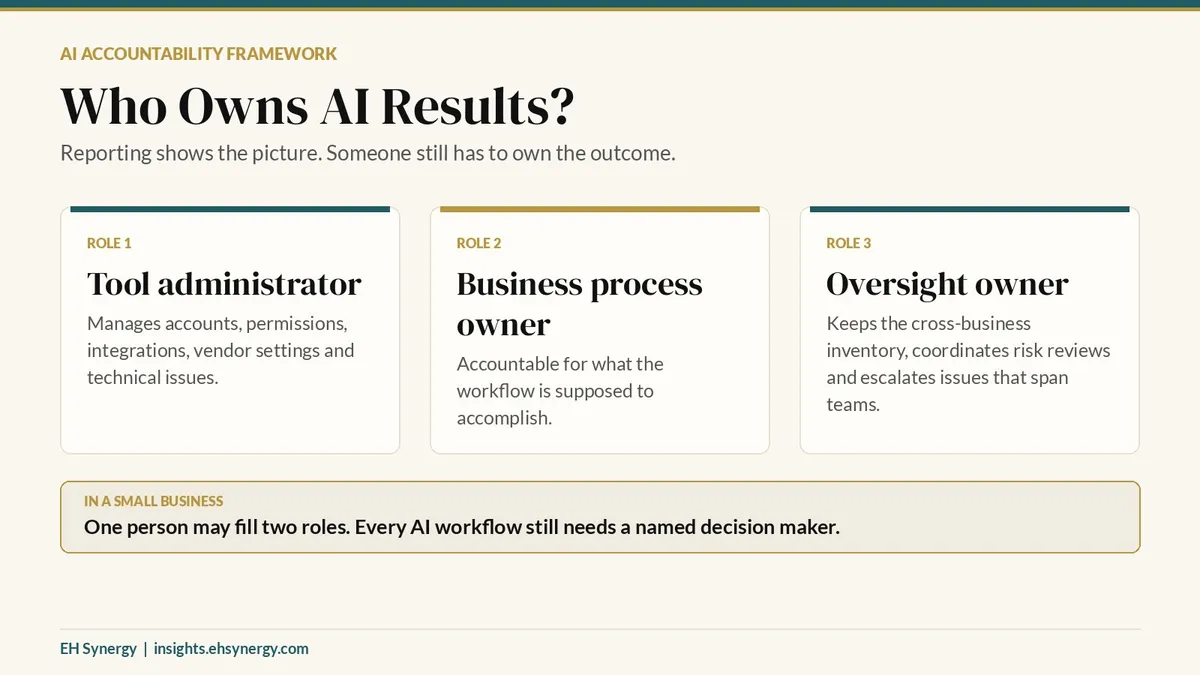
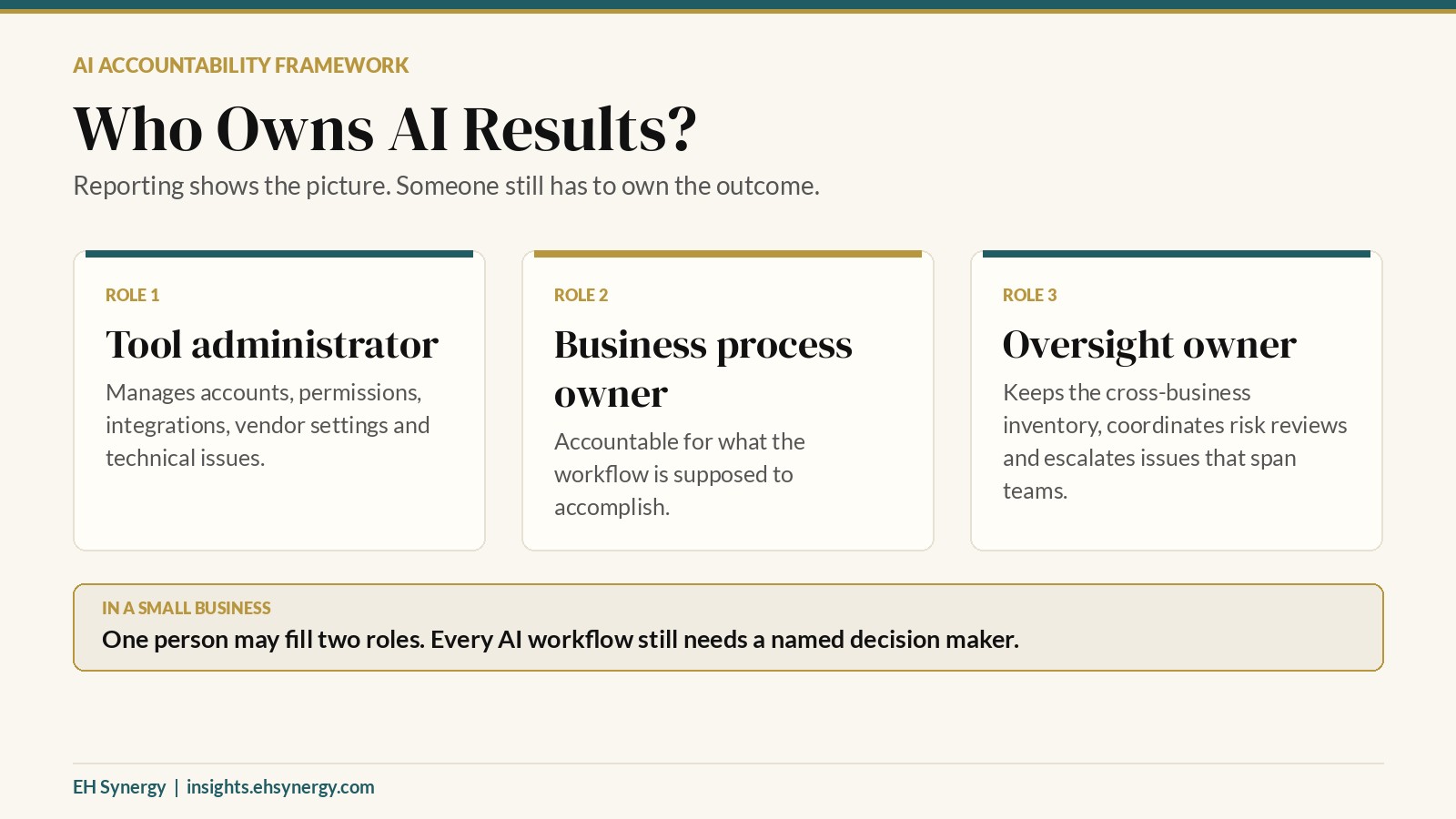
The tool administrator manages accounts, permissions, integrations, vendor settings and technical issues.
The business process owner is accountable for what the workflow is supposed to accomplish, such as accurate estimates, faster response times or fewer scheduling errors.
The oversight owner keeps the cross-business inventory, coordinates risk reviews, compares costs and escalates issues that span teams.
In a business with ten employees, the same person may fill two of these roles. That is fine. What is not fine is leaving everyone to assume somebody else is responsible.
A practical question: if the AI tool begins producing inaccurate estimates, who has authority to pause its use while the business corrects the price list?
If nobody can answer, the process is not ready for autonomous customer-facing action.
A Fictional Example: The Home Services Handoff
Consider a fourteen-person home services business. It uses an AI call summarizer, a quote-drafting assistant and an appointment scheduler.
A monthly report shows 80% employee usage. That number alone does not tell the owner whether customer service improved.
The sales lead notices that drafts require extensive editing. The scheduler notices duplicate appointments. The operations manager sees the monthly vendor bill. Each person holds a different piece of the story.
A better operating model gives the sales lead responsibility for quote accuracy, the scheduling lead responsibility for booking reliability, and the operations manager responsibility for maintaining a shared register and escalating cross-team problems.
The owner can then review business outcomes, not just subscription counts.
This is a hypothetical workflow, not a claim about LaunchDarkly or an EH Synergy client.
A Simple AI Workflow Ownership Register
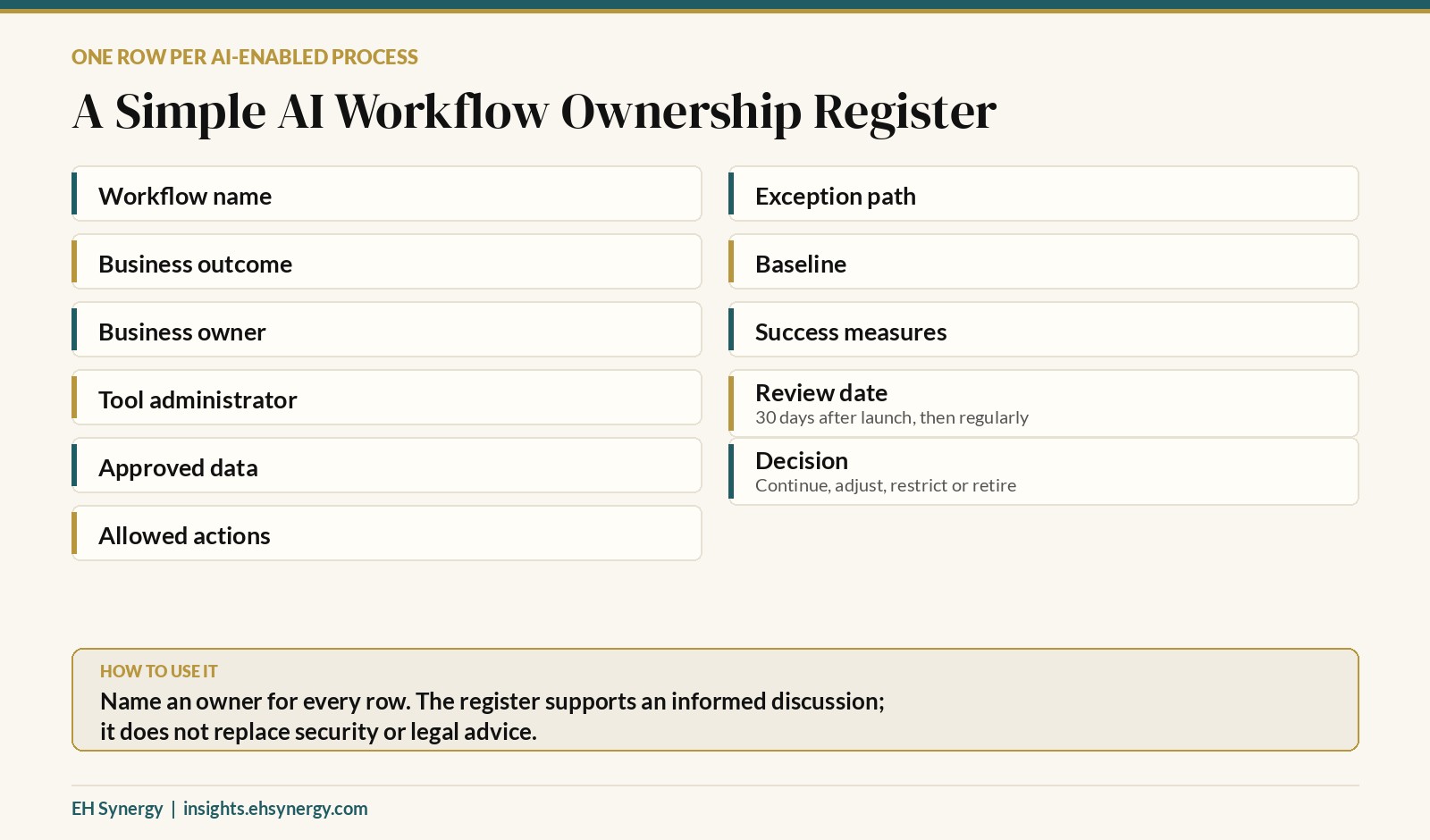
Create a spreadsheet with one row per AI-enabled process and these columns:
- Workflow name: e.g., draft service estimates.
- Business outcome: reduce time to send accurate estimates.
- Business owner: sales lead.
- Tool administrator: operations manager.
- Approved data: current service catalog and approved pricing only.
- Allowed actions: draft an estimate, not send it without approval.
- Exception path: staff review any unusual pricing or scope.
- Baseline: median turnaround time and correction rate before AI.
- Success measures: turnaround, errors, rework, customer complaints, employee adoption and total cost.
- Review date: 30 days after launch, then regularly.
- Decision: continue, adjust, restrict or retire.
This register does not replace security or legal advice. It creates the minimum accountability needed to have an informed discussion.
Five Steps to Put the Framework Into Practice
- Inventory before purchasing more. List the AI tools and agents already in use, their owners, vendors, permissions, costs and workflows. Look for overlapping subscriptions and unapproved connections.
- Map the real work. Follow a customer request from arrival to resolution. Record every handoff, review and correction. Ask employees where the tool saves time and where it creates new work.
- Assign decision rights. The process owner defines quality and outcomes. The administrator handles access and configuration. A designated approver authorizes sensitive changes. Document who can pause the workflow.
- Pilot and train. Test with synthetic or approved sample data. Explain the tool's limits, review expectations and escalation route. Do not treat a successful demonstration as evidence of production readiness.
- Measure value, then decide. Compare the post-pilot workflow with its baseline. Include elapsed time, error rates, employee corrections, adoption, customer experience, vendor costs and staff effort. Make a documented continue/change/stop decision.
How to Measure AI ROI Without Overclaiming
An illustrative estimate can begin with labor time:
Gross time value = (baseline minutes per task minus new minutes per task) × monthly task volume ÷ 60 × fully loaded hourly labor cost.
Then subtract the cost of review, corrections, training, vendor fees, implementation and maintenance.
For example, if a tool reduces drafting time but requires extensive manual checking, the net benefit may be smaller than the headline savings. Some benefits, including quality and reduced risk, require their own measures and should not be forced into an unsupported dollar amount.
Do not confuse an estimate with realized savings. Track the baseline, assumptions, observation period and evidence behind the calculation.
When a Fractional AI Consultant Can Help
A fractional advisor can facilitate the process without taking permanent ownership away from the business. The work may include interviews, workflow mapping, tool and data inventory, risk review, use-case prioritization, staff enablement, baseline measurement and a 90-day roadmap.
The deliverable should identify the decision maker for every recommended workflow, not simply list promising automations.
At EH Synergy, the principle behind an AI Opportunity & Transformation Assessment is to connect technology choices to operational readiness and measurable business decisions. The right recommendation may be to automate, redesign the handoff, improve training, limit permissions or postpone the purchase.
The Decision to Make This Week
Choose one AI tool your team already uses. Ask the process owner to explain what improved, how it was measured, and what happens when the output is wrong.
If those answers are unclear, your next investment may not be another platform. It may be a better operating process.
That is the distinction this LaunchDarkly role brings into focus: centralized visibility can support better decisions, but it cannot replace ownership of the work.
Source and Editorial Note
Official LaunchDarkly employer posting, Director, Internal AI Operations, accessed November 2, 2026: https://job-boards.greenhouse.io/launchdarkly/jobs/8109676003?gh_src=innovatorsroom
The employer describes intended responsibilities. This article offers a business interpretation and fictional examples. It does not claim LaunchDarkly has experienced the scenarios described.